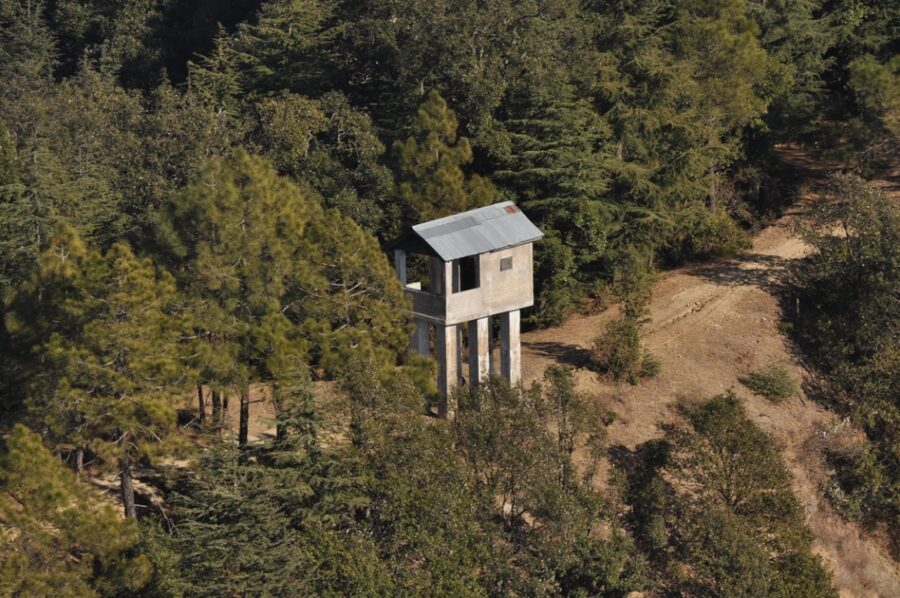
The sanctuary climbs from about 1,950 metres at the Manalsu stream to a little over 5,000 metres on the Hanuman Tibba ridge. That is a vertical rise of more than three kilometres inside a protected area smaller than the central business district of most Indian state capitals. Compress the entire ecological gradient of the western Himalayas into a single afternoon’s walk and you have, more or less, the Manali Wildlife Sanctuary.
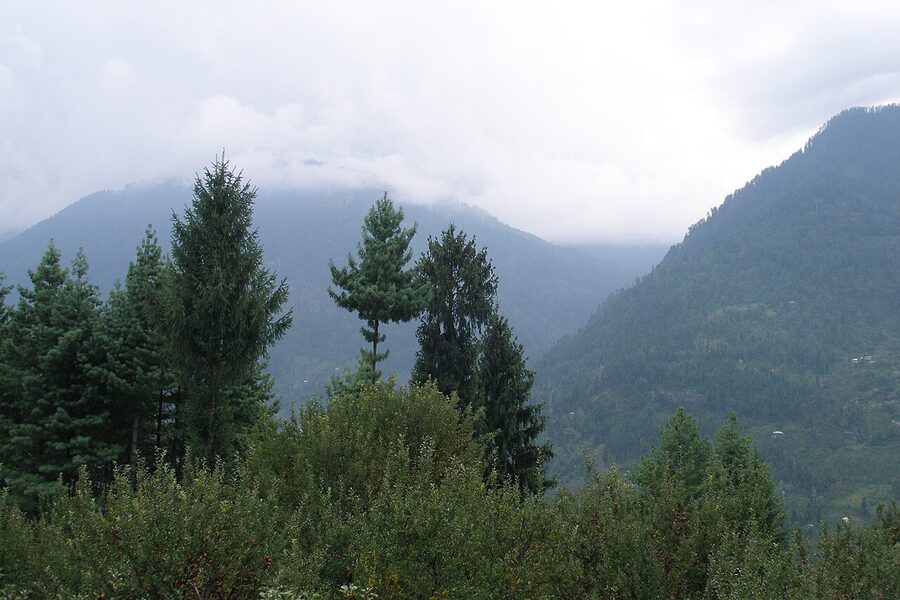
The Manali Wildlife Sanctuary, sometimes still listed on signage as the Manali Sanctuary or Van Vihar’s older administrative name, sits immediately west of Manali town in Kullu district. Its eastern boundary is the line of log huts and the Hidimba Devi temple grove. Its western boundary is the Hanuman Tibba ridge, which carries the watershed between the Beas and the Chenab. In between lies the catchment of the Manalsu khad, a narrow tributary that joins the Beas just upstream of Old Manali, and a band of forest that rises through deodar and kail at the bottom, into oak, walnut, and maple in the middle, into birch and rhododendron near the treeline, and finally into open alpine pasture, scree, and glacier at the top.
It was declared a sanctuary on 26 February 1954, under the old Punjab Birds and Wild Animals Protection Act of 1933. The official area on the records of the Himachal Pradesh Forest Department is 31.8 square kilometres, about 3,180 hectares. By the standards of Indian protected areas this is small. Khirganga National Park to the south, in the Parvati Valley, is more than twenty times the size. The Great Himalayan National Park further south is about thirty times the size. The reason the Manali sanctuary still matters, despite its modest area, is a combination of three things: it sits right at the edge of one of the most visited towns in the western Himalayas, the elevation range it covers is among the steepest of any Indian sanctuary, and it is the trailhead for Hanuman Tibba and the Manali Pass, two of the most demanding mountaineering objectives in this part of the country.
This guide is for the visitor who has a Manali trip planned and wants to know what is actually inside the sanctuary, what they are likely to see, what walking the lower trails feels like, when to go, and whether the day-trek is worth doing. It is not a trekking handbook for the high routes. The Hanuman Tibba expedition and the Manali Pass crossing into Lahaul are real mountaineering objectives that need a guide, a climbing permit from the Indian Mountaineering Foundation, and several weeks of preparation. We will note where they begin and what they involve, then point you to the federation that handles permits.
In This Article
- Where the Sanctuary Actually Is
- What’s in the Forest
- What You Might Actually See
- The Pheasants and Other Ground Birds
- The Deer and the High-Country Grazers
- The Carnivores You Almost Certainly Will Not See
- Walking the Sanctuary: The Day-Trail
- Lamadugh: The Longer Day
- Hanuman Tibba and the Manali Pass
- Practical: Entry, Timings, Permits, Costs
- When to Go
- October to Early November: The Best Window
- April to May: Spring Activity
- Mid-December to February: Snow and Silence
- Mid-July to Early September: Avoid
- What to Bring
- The Pressures the Sanctuary Faces
- Pairing the Sanctuary With the Rest of Manali
- What the Sanctuary Is and Isn’t
Where the Sanctuary Actually Is
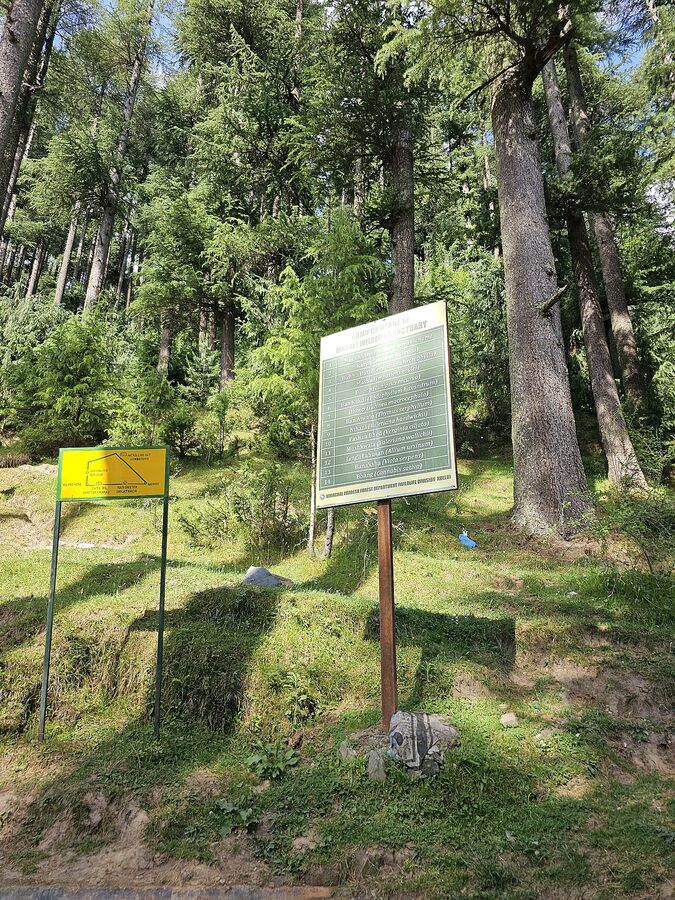
Most travellers arrive in Manali via the bus stand on the south side of town or via a private taxi from Bhuntar airport, fifty kilometres south. From the bus stand the sanctuary is a fifteen-minute walk: cross the bridge over the Manalsu nullah into Old Manali, follow the lane that climbs past the cafes, and the road winds up to the Manu Temple and the small entrance to the Van Vihar nature park, which sits at the eastern margin of the sanctuary. The forest gate proper, where the patrol path starts and where you’ll see the green Forest Department signboard, is a few hundred metres further on. The whole sanctuary lies between roughly 1,950 metres at the river and 5,200 metres on the high ridge, with Hanuman Tibba’s main summit at 5,932 metres just beyond the western boundary. The coordinates of the central point are 32°14′49″N 77°11′24″E if you want to find it on a map.
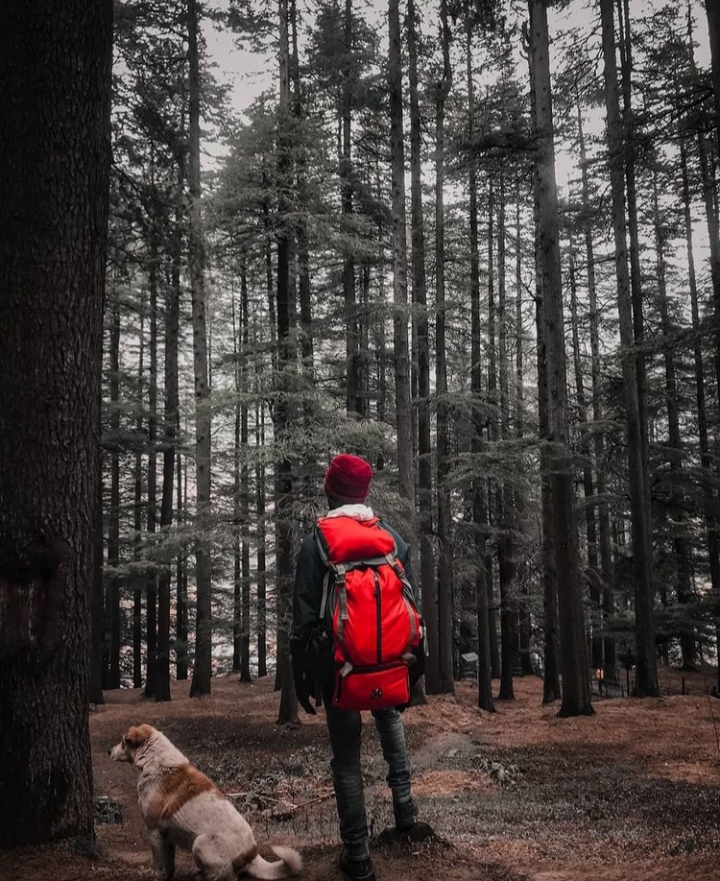
The town side of the sanctuary is on the right bank of the Manalsu, the narrow stream that drains the Manalsu valley. Old Manali sits on the eastern bank of this stream, which means that as soon as you cross the small bridge above Cafe 1947 you are functionally entering the sanctuary’s foothill zone. Within ten minutes of leaving the cafes behind you are inside dense deodar forest with the noise of the river falling away behind you. The contrast is what makes the place unusual. There are very few protected areas in India where you can walk from a working cafe district into reasonable wildlife habitat in under a quarter of an hour.
The western boundary, by contrast, is wild in a way that has nothing to do with town life. The Hanuman Tibba ridge is the watershed between the Kullu side and the Lahaul side. What falls as snow on the western face flows north into the Chandra and eventually into the Chenab, while the eastern face drains into the Beas. The ridge itself is permanently glaciated above about 4,800 metres, with the small Manali glacier sitting under the eastern face. The Manali Pass, at 4,950 metres, is the historical foot crossing from this watershed into Lahaul, used by traders for hundreds of years before the Atal Tunnel opened in 2020. The country on the far side of the pass is unrecognisably different from the forested Kullu side: a high cold desert, treeless, Tibetan-Buddhist in culture rather than Hindu.
What’s in the Forest
The first thing you’ll notice walking the lower trails is the smell. In summer, when the deodar resin warms in the sun, the whole lower forest smells like a combination of cedar pencils and damp moss. In winter, after fresh snow, you’ll smell almost nothing at all (the air is too cold to lift volatiles off the bark), but the silence is total because the snow muffles even your footsteps. These are the two extremes worth experiencing; the in-between months are subtler.
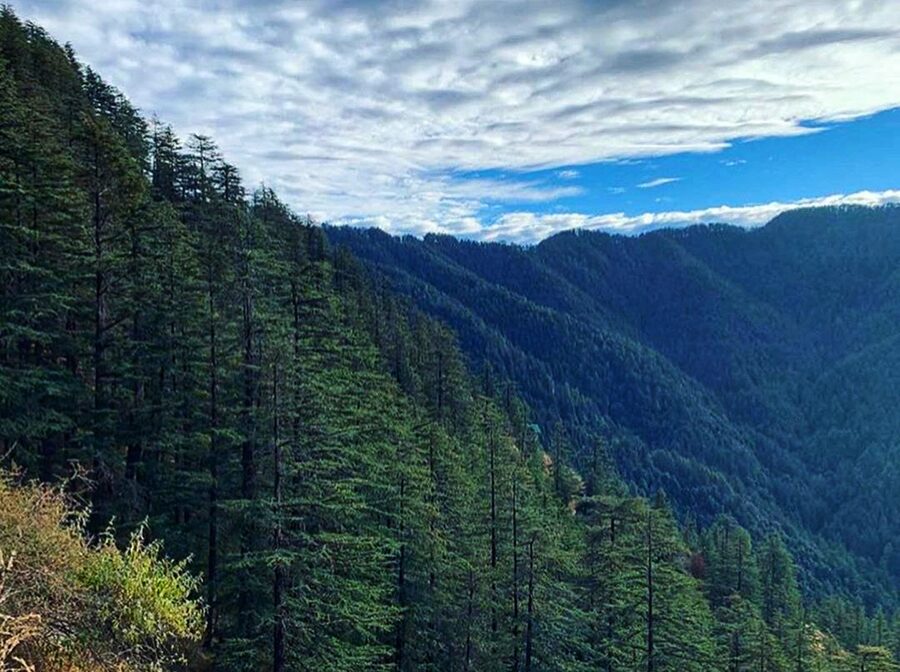
The dominant tree at the lower end of the sanctuary, between roughly 1,950 and 2,500 metres, is the deodar (Cedrus deodara), the same tree that gave the village of Devdar its name on the road up from Mandi. Deodar grows tall and straight here; the older specimens above the Manu Temple are over forty metres in height, with trunks straight enough to have been logged commercially throughout the colonial period. The Forest Department now protects them strictly within the sanctuary, but you can see the marks of historical felling on stumps that were never fully cleared. Mixed in with the deodar is kail (Pinus wallichiana, the blue pine), with longer needles and rougher bark, and at slightly higher elevations you start to see horse chestnut (Aesculus indica), walnut (Juglans regia), and maple (Acer caesium). The walnut trees in particular hold their leaves into late October and turn a deep yellow that contrasts against the dark green of the conifers.
Above about 2,800 metres the forest starts to change. Birch (Betula utilis), with its peeling white bark, becomes common, mixed with rhododendron of the smaller-flowered Himalayan species. By 3,200 metres you are in pure birch and juniper scrub. Above the treeline, around 3,600 to 3,800 metres depending on aspect, the forest gives way to open alpine grassland with patches of dwarf rhododendron and willow. This is the zone where the high pasture used to be grazed in summer by Gaddi shepherds bringing flocks up from Kangra. Some of that grazing still happens, though the Forest Department has reduced it inside the sanctuary boundaries since the 1990s. Above 4,500 metres there is no vegetation worth mentioning: bare rock, scree, snowfields, and the small glacier at the foot of Hanuman Tibba.
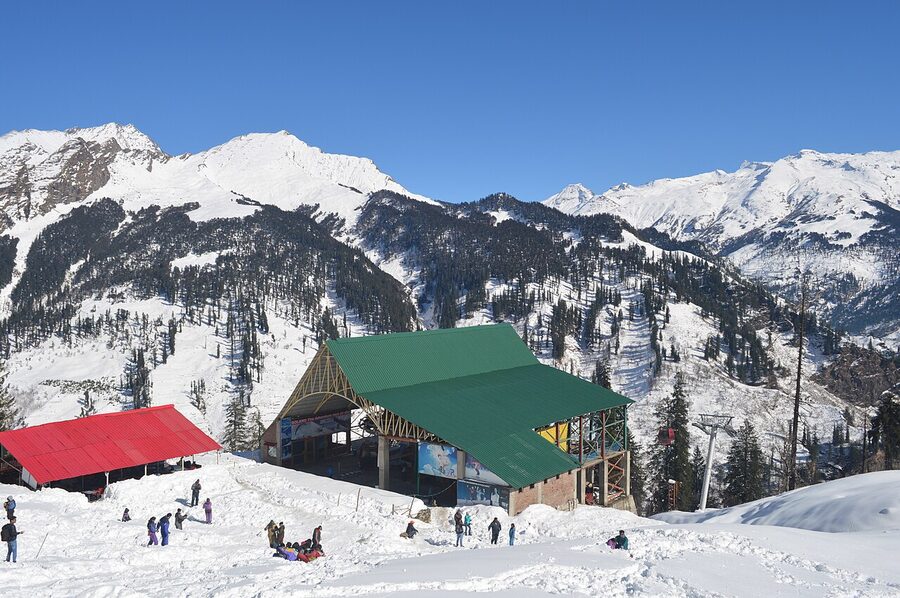
The compression of these zones into a small horizontal distance is what makes the sanctuary biologically interesting. Most national parks in the western Himalayas spread the same gradient over fifty or sixty kilometres of valley. Here you can move through deodar, oak, birch, and alpine in a single very long day on foot, though that is not a walk most casual visitors should attempt. Most people see only the deodar and oak zones on the day-trail.
What You Might Actually See
The fauna list for the sanctuary is impressive on paper. Snow leopard, brown bear, Himalayan black bear, leopard, musk deer, ibex, Himalayan tahr, goral, serow, barking deer, several pheasant species, and a good list of smaller mammals. The honest summary is that you will not see most of them. Snow leopards are notoriously hard to see anywhere (even the dedicated leopard-tracking trips into Spiti’s Kibber sanctuary in February have a hit rate well under one in three days), and the population in the upper Manali sanctuary is a handful of animals across thousands of hectares of broken cliff terrain. What you can realistically expect on a day visit is birds, the occasional barking deer, signs of larger animals, and perhaps a langur troop on the lower forest path.
The Pheasants and Other Ground Birds
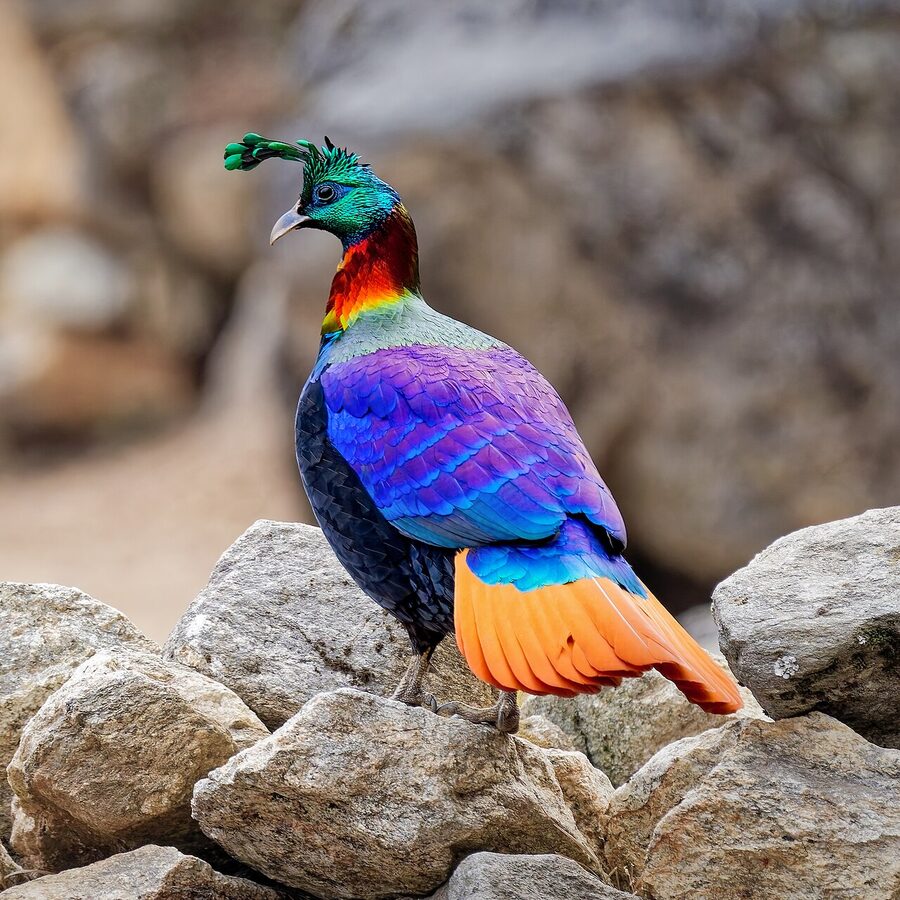
The most realistic mammal-or-bird sighting in the sanctuary is the Himalayan monal (Lophophorus impejanus), the state bird of both Himachal Pradesh and Uttarakhand. The males are unmistakable: a roughly chicken-sized ground bird with a metallic green head crest, a copper-orange back, and iridescent blue-green wings. They feed on the alpine grass slopes between about 2,800 and 4,000 metres, often in family groups, and are easiest to spot in early morning or late afternoon between October and April when they come down to lower elevations. The Lamadugh meadow, two to three hours up from the trailhead, is the standard place birders look for them. eBird has the Manali Wildlife Sanctuary listed as an active hotspot under hotspot code L4338058, with monal sightings recorded most months of the year.
The koklass pheasant (Pucrasia macrolopha) is harder. Smaller and more cryptically coloured than the monal, with a dark mottled body and a thin pointed crest, the koklass prefers the dense oak and conifer forest at middle elevations and is much more often heard than seen. Its call is a loud crowing two-note that carries through the forest at dawn. If you are walking the patrol path before sunrise in winter, you will probably hear at least one. The Western tragopan (Tragopan melanocephalus) is also recorded from the sanctuary but is genuinely rare; the entire global population of this species is estimated under five thousand birds, and Manali is at the edge of its range.
Other ground birds and high-altitude specialists include the Himalayan snowcock, snow partridge, snow pigeon, chukar partridge, and chakor. Tree birds you’ll see commonly on the lower trails include the green-backed tit, several nuthatches, treecreepers, and various warblers depending on season. The Kullu Forest Division’s bird list for the sanctuary runs to over 130 species; serious birders should bring binoculars and a field guide rather than rely on phone identification.
The Deer and the High-Country Grazers
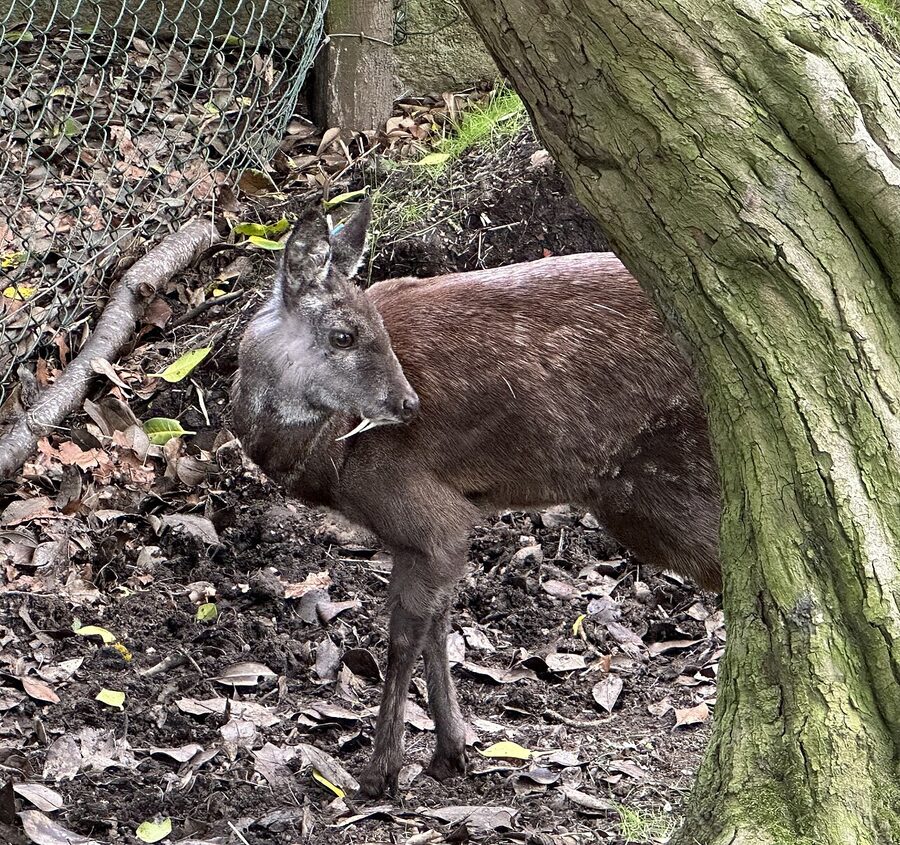
The Himalayan musk deer (Moschus leucogaster) is the species the sanctuary’s wildlife list leads with, and it remains one of the harder mammals in India to see. Small, hare-coloured, with the males carrying long downward-curving canine tusks rather than antlers, the musk deer lives in the dense oak and birch forest between about 2,400 and 4,200 metres. It is solitary, crepuscular, and shy. The species is endangered globally, hunted historically for the musk gland used in perfumery, and protected under Schedule I of the Indian Wildlife Protection Act. The chance of seeing one on a day walk is essentially zero. The chance of finding fresh hoof prints in soft snow above Lamadugh in February is much higher, and the Forest Department’s anti-poaching patrols that work this section will tell you where they have been seeing tracks if you ask politely at the gate.
The more visible deer is the barking deer or muntjac (Muntiacus muntjak), a small reddish-brown deer that gives a sharp dog-like bark when disturbed. You will probably hear one at some point on a forest walk, and with luck see one breaking through the undergrowth. The barking deer is common in the lower oak forest below 2,400 metres.
Higher up, the grazing community changes. Herds of Siberian ibex (Capra sibirica) come down into the alpine zone in summer from the upper crags, sometimes seen on the slopes below Hanuman Tibba in July and August. The ibex of this range carry the long curved horns that older males develop into the second metre of length. Goral (Naemorhedus goral), a goat-antelope that looks more like a small grey wild goat than a deer, lives on the steep grass and rock slopes between about 1,800 and 3,800 metres and is the second most commonly seen large mammal after barking deer. Himalayan tahr (Hemitragus jemlahicus) and serow (Capricornis sumatraensis) are both recorded but rare here; both are more reliably seen in the protected areas further south.
The Carnivores You Almost Certainly Will Not See
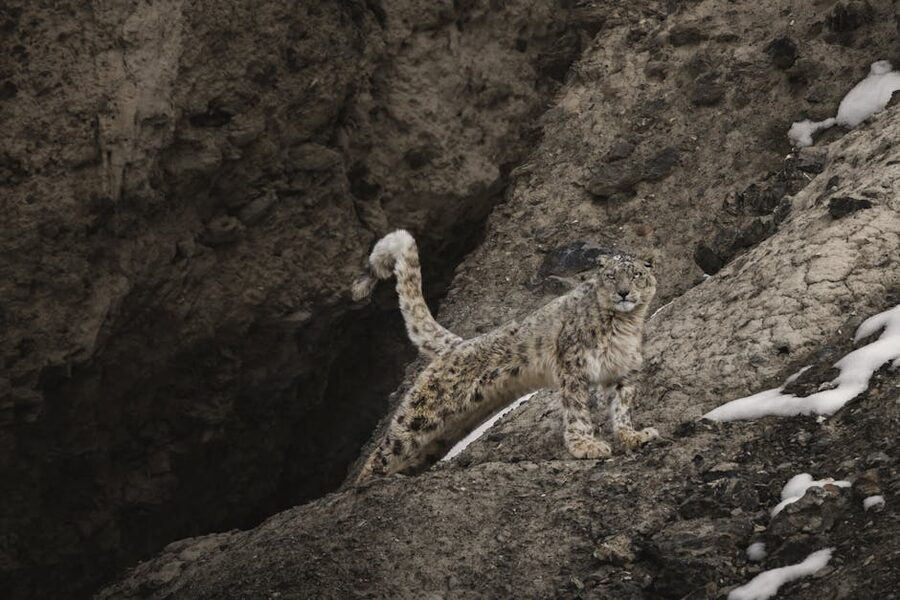
The carnivore list is the part of the sanctuary brochure that catches everyone’s attention, but it is also the part most likely to disappoint. The snow leopard (Panthera uncia) is the headline species. The Himachal Pradesh state animal, listed as Vulnerable on the IUCN Red List, with the global population estimated between 4,000 and 6,500 animals across twelve countries. Inside the Manali sanctuary the snow leopard occupies the upper crags above about 4,000 metres, mostly the rock and scree below the Hanuman Tibba ridge. Sightings are rare even by camera trap. If you want a realistic chance of seeing a wild snow leopard, the Kibber Wildlife Sanctuary in Spiti is the place; reputable Indian wildlife operators run February tracking trips out of Kaza for around 80,000 to 1,20,000 rupees per person for a week.
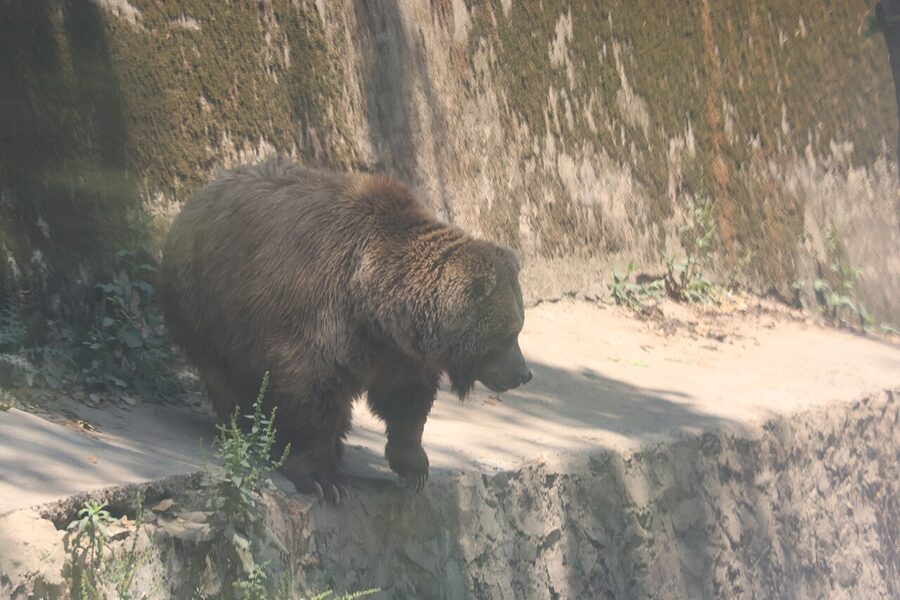
The Himalayan brown bear (Ursus arctos isabellinus) is the high-altitude bear, with a population in the upper sanctuary that is small but stable. Like the snow leopard it lives mostly above the treeline and is rarely encountered by visitors. The Himalayan black bear (Ursus thibetanus laniger) is more common at middle elevations and occasionally raids apple orchards on the sanctuary’s lower margin in autumn. The Forest Department posts seasonal warnings at the gate when bear activity is reported nearby; take them seriously. Both bear species are protected under Schedule I of the Wildlife Protection Act and are aggressive when surprised.
The leopard (Panthera pardus) is recorded from the sanctuary’s lower oak forests and occasionally takes village livestock in the surrounding settlements. Like the snow leopard, it is almost never seen by visitors. Smaller mammals that turn up more reliably on the lower trails include the Himalayan yellow-throated marten (a striking medium-sized mustelid that hunts in trees), the Himalayan palm civet, the red flying squirrel, and on the rocky slopes the Himalayan mouse hare or pika. The Indian crested porcupine is occasionally seen at dusk on the lower forest road.
Walking the Sanctuary: The Day-Trail
The standard day-walk, and the one the great majority of visitors will do, is the circuit that begins at the Manu Temple in Old Manali, follows the Forest Department patrol path up the right bank of the Manalsu, crosses higher up via a footbridge, and comes back down the opposite bank. The full loop is around 11 kilometres with about 1,140 metres of elevation gain, which is a five to six hour walk for a moderately fit walker carrying water and a packed lunch. The first hour and a half from the Manu Temple is mostly under deodar canopy, gaining altitude steadily on a well-graded forest path with switchbacks. The second section above the Forest Department rest huts climbs more steeply through oak and walnut into the lower meadow zone. The high point of the standard loop is a small grass clearing at around 2,900 metres with a view back across the valley to the Pir Panjal range. The descent on the return side drops back into deodar and rejoins the upper Old Manali road.
The trail is graded easy by Indian trekking standards, and the AllTrails community rates the Lamadugh trek (the longer variant continuing up to the high meadow) at 4.5 stars over 207 reviews. For a day-walker not used to altitude, the standard loop is more than enough; you will be at 2,900 metres for the high point and you will feel it on the climb. Carry at least 1.5 litres of water per person, a packed lunch, sun cream, and a windproof or fleece even in summer because the upper section is exposed and the wind cuts hard once you are above the treeline. Trail shoes with grip are necessary; the path is dusty in summer and slippery in patches in monsoon and after fresh snow. Plain walking shoes will not be enough on the steeper sections.
The path is not signposted in any meaningful way once you are past the Forest Department gate. There are several minor paths that branch off and lead nowhere useful. Take the wider, more obviously trodden line at every junction and you will end up on the right route; the Manalsu stream is on your left as you ascend, which gives you a constant reference. If you are walking solo, tell your accommodation where you are going and what time you expect to be back, and take a phone with charge. There is patchy mobile signal on the lower section of the trail and intermittent coverage higher up.
Lamadugh: The Longer Day
If you have the legs and the time, the Lamadugh extension is the more rewarding walk. From the high point of the standard loop, the trail continues up through birch forest and emerges into the Lamadugh meadow at around 3,400 metres. This is the high alpine pasture at the head of the Manalsu valley, ringed by ridges, with a small seasonal stream running through the middle. In summer the meadow is grazed and you may see Gaddi shepherd encampments. In winter it is under snow and silent. The full Lamadugh return from Old Manali is around 18 kilometres and a long day, eight to nine hours with breaks. Most walkers split it over two days by camping at the meadow, which is permitted with prior approval from the Forest Department office at Aleo.
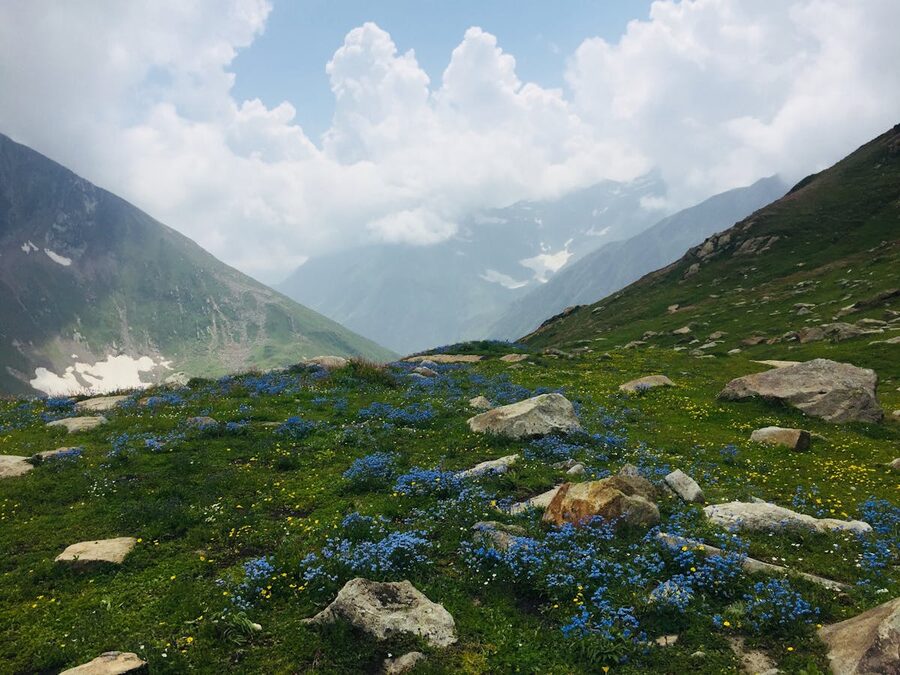
The view from the upper end of Lamadugh on a clear morning takes in the whole northern face of the Pir Panjal: Indrasan and Deo Tibba to the east, the line of unnamed peaks running west towards Hanuman Tibba, and the head of the Beas Kund valley due north. October is the cleanest month for visibility; the post-monsoon air is clear, the colours are still in the lower forest, and the high snow has not yet built up. Avoid Lamadugh in July and August during the monsoon; the trail is slippery and the leeches in the lower forest are persistent.
Hanuman Tibba and the Manali Pass
These are the high mountaineering objectives that lend the sanctuary its real altitude range and they are not for casual visitors. Hanuman Tibba (5,932 m) is the dominant peak on the sanctuary’s western boundary and a serious climb requiring full mountaineering equipment, a high-altitude permit from the Indian Mountaineering Foundation, and an experienced guide. The standard route ascends from the Beas Kund base camp on the north side of Solang and crosses the long west ridge over several days. First climbed in 1939 by a small Anglo-Indian party, the peak now sees a handful of expeditions a year. Most attempts are made in May–June or September–October; the peak is rarely climbed in winter.
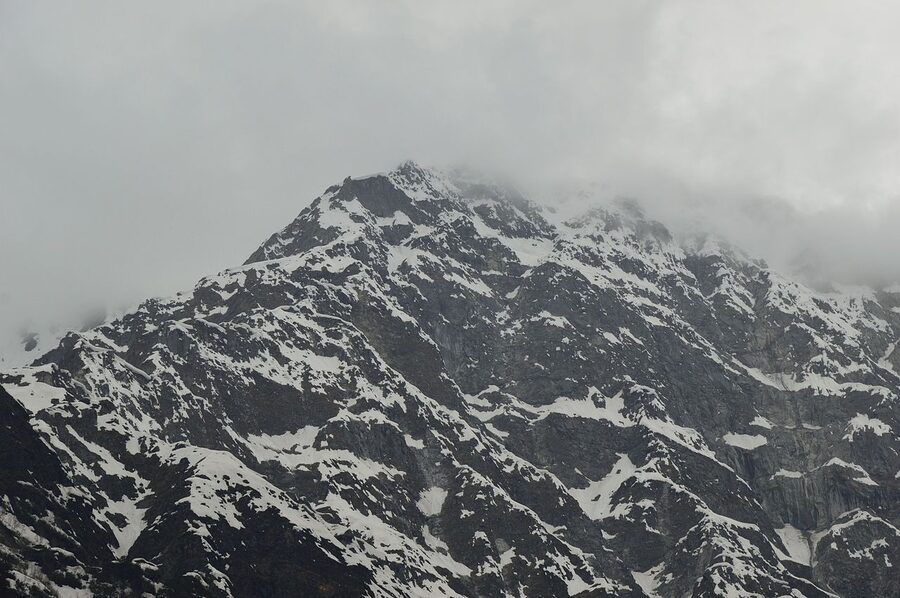
The Manali Pass (4,950 m), historically known as the Manali Galu in local Pahari, is the foot crossing from the upper Manalsu into Lahaul. Used for centuries by Gaddi shepherds and salt traders before the modern road was built over Rohtang Pass and then under the Atal Tunnel, the pass is still walked occasionally by experienced trekkers as a four to five day route from Manali to Khoksar in Lahaul. It is more demanding than the popular Hampta Pass crossing further east: steeper, less marked, and with a glacier section near the top that requires basic snow craft. Anyone considering it should go with a registered Manali-based mountaineering guide and have done at least one previous high-altitude trek.
For routes onward into Lahaul that do not require a guide, see our guide to Lahaul and Spiti; the Atal Tunnel has made the Lahaul side accessible from Manali year-round in well under an hour.
Practical: Entry, Timings, Permits, Costs
The sanctuary entry fee, charged at the Van Vihar gate near the Manu Temple, is a token 10 rupees per Indian visitor; foreign visitors pay 50 rupees. Camera fees are nominal: 25 rupees for a still camera, more for video. The gate is open between 7 AM and 6 PM in summer (April to October) and 8 AM to 5 PM in winter (November to March), though the patrol path itself is technically open 24 hours and locals walk the lower section in early morning. The recommended hours for wildlife are early morning, between 6 AM and 9 AM, and late afternoon from 4 PM until dusk. The middle of the day is when the forest is quietest in mammal terms and noisiest in tourist terms.
For day-walks within the sanctuary, no special permit is required beyond the entry ticket. For overnight camping at Lamadugh or higher, you need to inform the Forest Department office at Aleo (about 2 km south of Mall Road) and pay a small camping fee. For the Hanuman Tibba climb and the Manali Pass crossing, an Inner Line or restricted area permit is not currently required for Indian nationals, but a mountaineering permit from the IMF and a registered guide are mandatory. Foreign nationals attempting peaks above 6,000 metres need additional clearance through the IMF; below 6,000 metres there is currently no special restriction, though regulations change periodically and you should check with the Aleo Forest Office before planning.
The Forest Department phone number for the Aleo office is +91 1902 252 360, though the line is intermittent and walking in to the office in person is more reliable. The Manali Forest Division falls under the Kullu Forest Circle of the Himachal Pradesh Forest Department; the state-level wildlife wing maintains a useful sanctuaries register on the Himachal Pradesh Forest Department site. For verified species lists and conservation status, the ENVIS Centre on Himachal Pradesh forests is the academic reference.
When to Go
The sanctuary is open year-round but offers very different experiences in different months. The brief version: October and early November for the clearest air and best photographic light; April and May for the wildflowers and the highest chance of bird activity in the middle elevations; mid-December through February for the deep-snow trail and the genuine off-season silence. Avoid mid-July to mid-September for the monsoon, when the trails are slippery and leeches are active.
October to Early November: The Best Window
The post-monsoon air clears in the third week of September and stays clean through to the first heavy snow, which usually lands sometime in mid to late November depending on the year. Daytime temperatures on the lower trails sit between 12 and 20 degrees, dropping into single digits at night. The deodar holds its green; the walnut and maple turn yellow and copper from mid-October. The crowds in central Manali drop sharply once the school holidays end in early September. Hotel rates fall by half. October also catches the second peak of bird activity as residents that summer at higher elevations move down for the winter. If you can choose your dates, the third week of October is the single best week of the year for the sanctuary.
April to May: Spring Activity
Spring is when the breeding birds are at their most visible. Monal males are in full plumage and calling from the meadow edges; koklass are calling at dawn from the oak forest. The undergrowth is thinner than in monsoon, which makes it easier to see ground birds and small mammals. The downside of April and May is that this overlaps with the start of the heavy summer tourist season in Manali itself; book accommodation outside central Manali (Old Manali, Vashisht, Naggar) if you want to avoid the queues. For more on choosing where to stay, see our destination guide to Manali and our shortlist of Manali hotels, or the broader overview of hotels across Himachal if you’re planning a longer multi-stop trip.
Mid-December to February: Snow and Silence
This is the off-season for the sanctuary in numbers terms, with almost no tourist traffic on the trails, but it is a beautiful time for anyone who is properly equipped for snow. The lower forest is silent; mammal tracking is far easier with snow on the ground than with dry forest floor, and the chance of spotting prints of musk deer, marten, or even the occasional leopard is much higher. Daytime temperatures sit around freezing and drop to minus five or minus ten at night. Trail shoes will not be enough; you need proper insulated boots with grip, ideally with micro-spikes or instep crampons for the steeper sections. The high routes (Lamadugh and beyond) are not safely passable without snow-craft experience between mid-December and mid-March.
Mid-July to Early September: Avoid
The monsoon hits the Kullu valley hard. Daily afternoon rain on most days through July and August makes the lower trails slippery and miserable; the steeper sections of the upper trail become genuinely dangerous because of soft ground and sliding scree. Leeches are active in the lower oak forest from mid-June through September. Landslides on the road in from the south are routine; the catastrophic 2023 monsoon damage along the Mandi-Kullu stretch is now repaired but the underlying instability has not changed. If your only available window is monsoon, accept that the day-walk will probably be wet and the high routes will not be on the menu.
What to Bring
For a day-walk on the standard loop, the essentials are simple. Water (1.5 to 2 litres per person), packed lunch (the Old Manali cafes will pack you a sandwich and fruit if you ask the night before), sunscreen, sunglasses, a fleece or windproof jacket regardless of season, a small first-aid kit, and a torch or headlamp in case you are slower than planned and end up walking out at dusk. Trail shoes or low hiking boots; no plain trainers. A camera with a zoom lens if you want any chance of useful bird photographs. Phone cameras are not adequate for the typical 20-to-50-metre distance to a perched bird.
What not to bring: no plastic packaging or single-use bottles inside the sanctuary (the Forest Department enforces this and will turn you back at the gate if you have obvious plastic), no music players, no food intended for animals (bears in particular), no drones (a separate aerial photography permit is needed and is not casually granted). Dogs are not permitted past the gate. If you are coming with children under eight, the standard loop is too long; do the lower section as far as the first viewpoint (about 90 minutes return from the gate) and turn back.
The Pressures the Sanctuary Faces
The Manali sanctuary is recognised as a Key Biodiversity Area (site code 18160 on the global KBA register) for its pheasant populations and high-altitude species. The KBA assessment lists several active threats: livestock grazing pressure on the alpine meadows above the treeline, small-scale plant gathering for traditional medicine, occasional unauthorised logging on the lower margins, mining and quarrying pressure on the access road, and growing recreational impact from day-trippers. The Forest Department has done a credible job of enforcement on the recreational pressure (the gate ticketing, the plastic ban, and the patrol path that is genuinely patrolled), but the fundamental problem is that the sanctuary sits next to one of the busiest tourist towns in the western Himalayas. The trail you will walk has more visitors in a single peak-season day than the entire sanctuary saw in a typical week thirty years ago.
The Atal Tunnel, opened in October 2020, has had a secondary impact. By making Lahaul accessible year-round, it has redirected some of the heavy summer traffic that used to back up at Rohtang Pass. That has reduced air pollution and idling vehicle pressure on the Solang side directly above the sanctuary. It has also brought more total annual visitors to the broader Manali region. Net effect on the sanctuary itself is probably mildly negative, but the data is thin and academic studies are ongoing.
The most useful thing a visitor can do is to walk the trail without trace. Carry your packaging out. Stay on the patrol path. If you see something interesting (a snowprint, a fresh scat, a bird in good light), take the photograph but don’t post the GPS coordinates publicly, especially for sensitive species like musk deer or snow leopard. The Forest Department staff at the gate will tell you what is being seen recently and where the active patrol routes are; they are generally welcoming if you show genuine interest.
Pairing the Sanctuary With the Rest of Manali
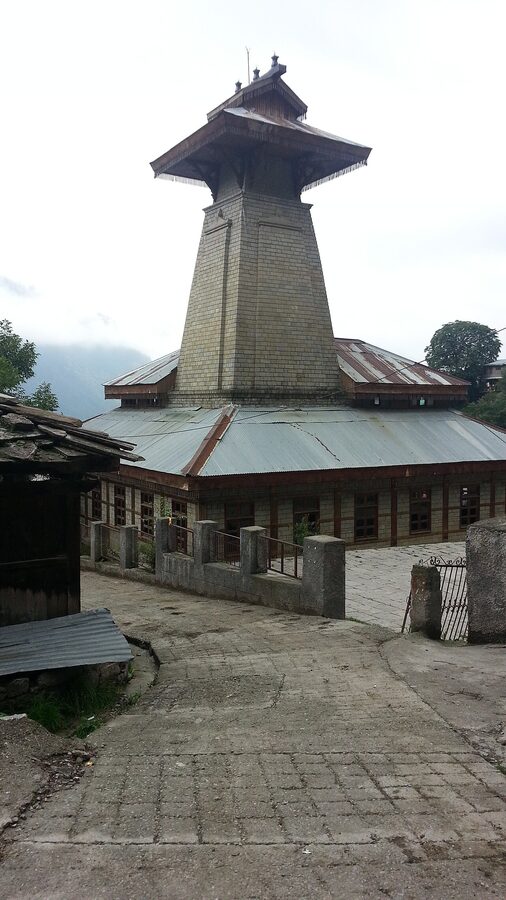
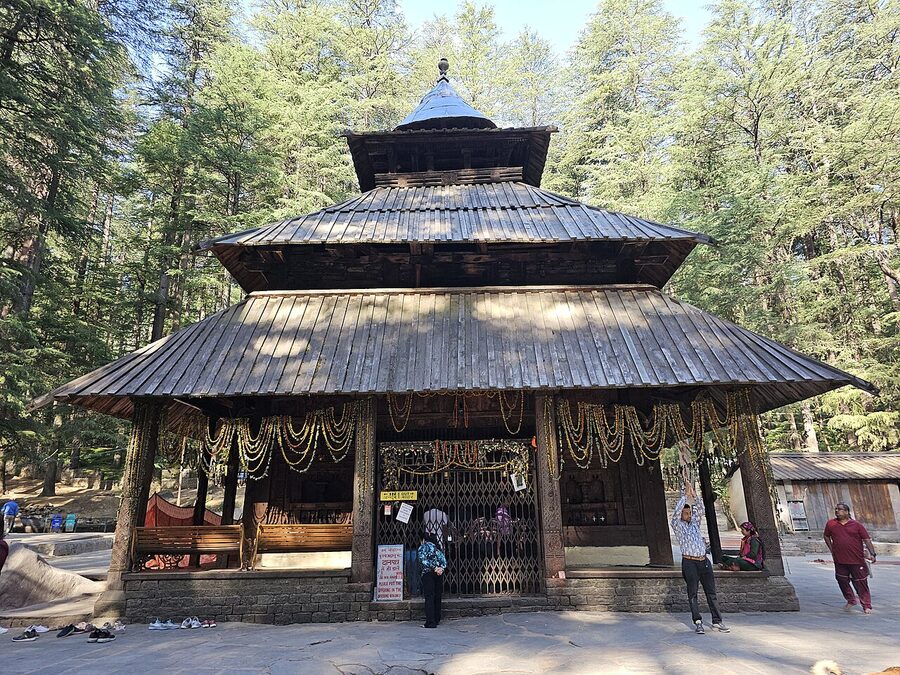
For most visitors the sanctuary is half a day to a full day, slotted into a longer Manali itinerary. The morning works best for the wildlife; afternoons can be spent on the cultural sites. The Hidimba Devi temple sits in a deodar grove just on the eastern edge of the sanctuary, a five-minute walk from the Forest Department gate, and is the obvious pairing. See the temple early before the tour buses arrive, walk into the sanctuary for the morning, come back down to Old Manali for lunch at one of the cafes along the river. The Manu Temple itself, which sits at the trailhead, is a smaller and quieter shrine dedicated to the lawgiver Manu, with the only temple in India dedicated to him.
If you are in Manali for three days or more, the Lamadugh extension is worth a full day on its own. For longer trips, the sanctuary pairs naturally with day visits to Solang, the Atal Tunnel, and Sissu on the Lahaul side. For trip planning at the package level, see our overview of Himachal tour packages and Delhi to Manali tour options. Couples planning a romantic Kullu-Manali trip should also look at the dedicated honeymoon in Himachal guide, which covers the quieter base options at Naggar and Sethan.
For broader background on the state’s wildlife reserves, including the larger Great Himalayan National Park, Pin Valley National Park, and the Chail and Simbalbara sanctuaries, our overview of wildlife in Himachal sets the regional context. The Manali sanctuary is small and close to a town; the Great Himalayan National Park, by contrast, is enormous and remote, and the smaller Chail Wildlife Sanctuary further south sits at lower elevation in pine and oak country with a very different mix of species. All three have their place in a longer Himachal trip. The other side of a Manali visit is the cultural circuit: see our overview of tourist attractions across the state for shrines, temples, and festivals beyond the Kullu valley.
What the Sanctuary Is and Isn’t
The Manali Wildlife Sanctuary is not a safari park. There is no jeep track, no organised wildlife tour from the gate, no realistic prospect of ticking off a list of marquee species in a single visit. Travel agents who sell “snow leopard sighting” trips here are selling you something that does not really exist; the chance of a wild snow leopard sighting on a casual day-trip is functionally zero. The KBA assessment, the academic species lists, and the eBird hotspot data all confirm what the species are present, but presence and visibility are very different things in the western Himalayas.
What the sanctuary is, instead, is a genuinely good day-walk in real Himalayan forest, ten minutes from a working town, with a chance, over the course of a properly timed visit, of seeing several pheasant species, one or two of the smaller deer, and the smaller mammals of the lower forest. It is the closest thing in the Manali area to an honest wilderness day. For the visitor who has come to Manali primarily for the cafes, the Mall Road shopping, and a Solang day-trip, the sanctuary will probably feel slow. For the visitor who came because they wanted to walk in the Himalayas, it is the best half-day in the immediate area.
Go early. Walk slowly. Sit somewhere quiet for fifteen minutes at a time. The forest will tell you what is there if you stop trying to cover ground.