You walk in expecting a goddess and find a fire. There is no idol in the inner sanctum at Jwalamukhi. There never has been. The deity here is a row of small blue flames burning out of a fissure in the rock, and they have been burning, by every available account, longer than anyone has bothered to keep track.
This is one of the 51 Shakti Peethas of Hindu tradition, the places where the limbs of Sati are believed to have fallen when Vishnu cut her body apart with his Sudarshana Chakra. Each peetha houses a fragment of the goddess. At Jwalamukhi, the fragment is her tongue, and the tongue is represented by the flame. You make your offering not to a face carved in stone but to a fire that burns from the bedrock with no fuel anyone has ever traced.
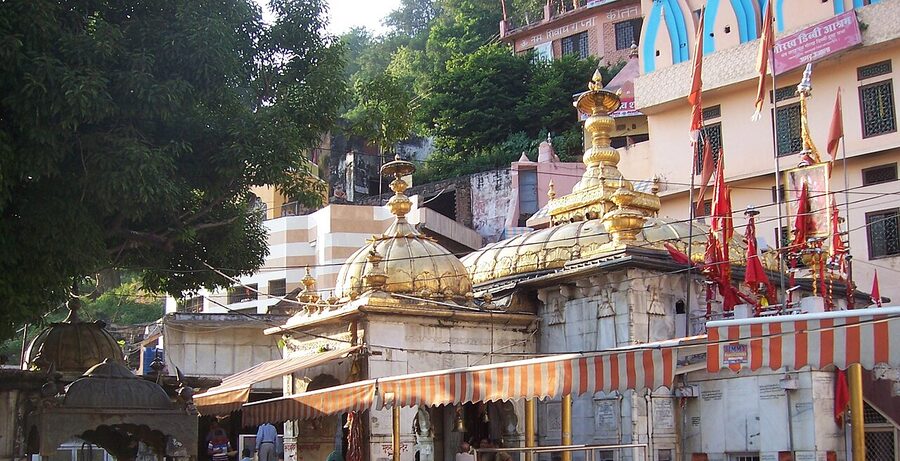
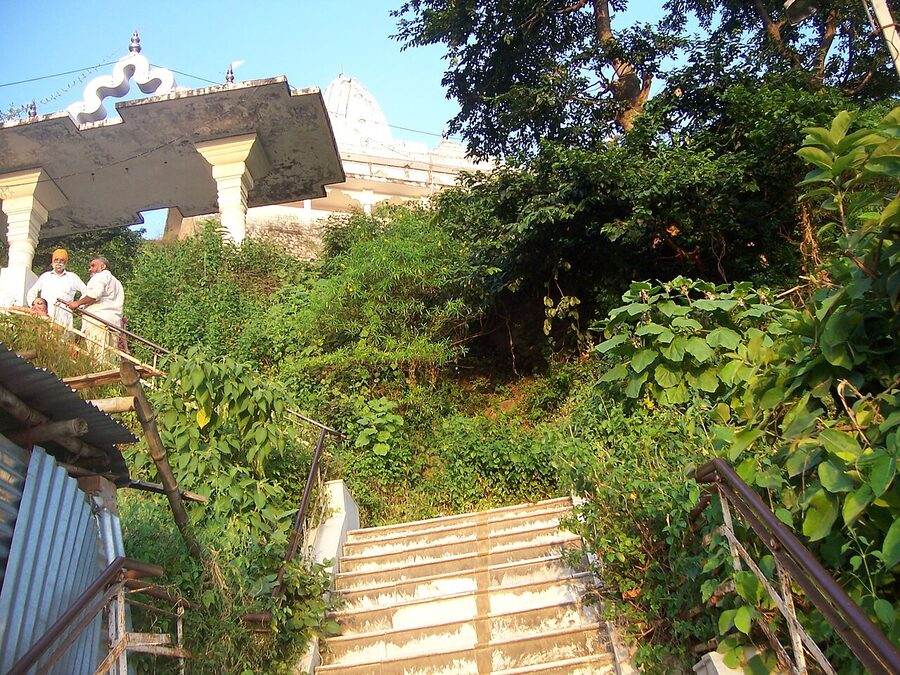
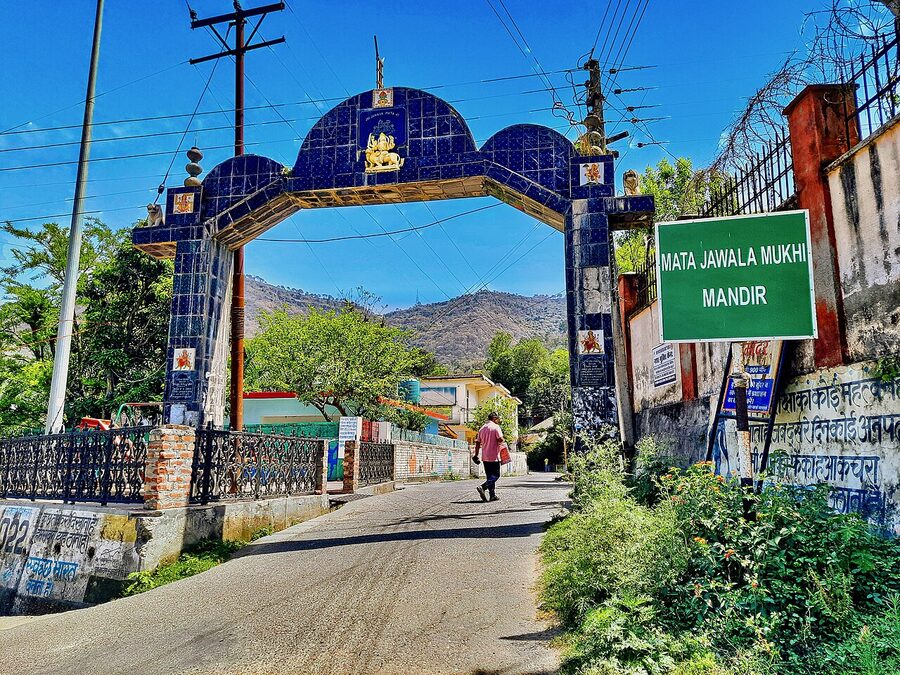
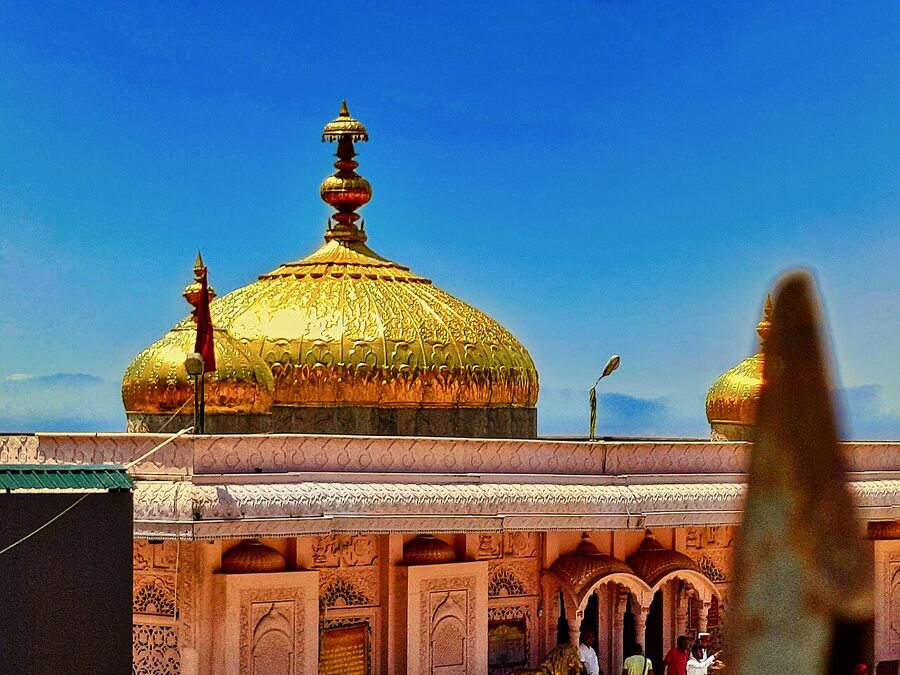
The temple sits in Jwalamukhi town, a small nagar parishad in Kangra district of Himachal Pradesh, on a low ridge of the Shivaliks called Kalidhar. The 2011 census put the town’s population at 5,361, which means it is small enough that the temple is the centre of everything and nobody pretends otherwise. The buses pull up at the foot of the ridge. A short stepped lane climbs to the entrance. Above the entrance is a golden dome, donated by Ranjit Singh’s son Maharaja Kharak Singh in the early 19th century, and through the silver-plated folding doors you’ll find the pit where the flames burn.
This guide walks through what the flames actually are, the legends behind them, the daily aarti schedule and the structure of a darshan, the two Navratri fairs that double the town’s population every spring and autumn, the route in from Delhi or Dharamshala, and the four sister Shakti Peethas in the surrounding district that most pilgrims fold into a single Kangra circuit. Names, distances, and timings come from the official Kangra district administration site, the goddess temple’s own publications, the Wikipedia entries grounded in Shanti Lal Nagar’s The Temples of Himachal Pradesh, and editorial sources cited at the foot of the piece. Verify temple timings on the official Kangra Temples portal before you travel, the morning aarti shifts slightly between summer and winter.
In This Article
- The Flame in the Rock
- The Shakti Peetha Story: How Sati’s Tongue Came to Rest Here
- The Cowherd, the King, and the Building of the Temple
- Akbar and the Flame That Wouldn’t Go Out
- The Nine Flames and What Each Goddess Stands For
- Inside the Mandir: What You’ll Actually See
- The Daily Aartis: Five Times, Day and Night
- Navratri and the Two Big Fairs
- Getting to Jwalamukhi
- Where to Stay in Jwalamukhi Town
- What to Eat and Where
- The Other Temples Around Jwalamukhi
- The Wider Shakti Peetha Circuit in Kangra
- Practical Notes for Your Darshan
- When to Go (and When to Avoid)
The Flame in the Rock
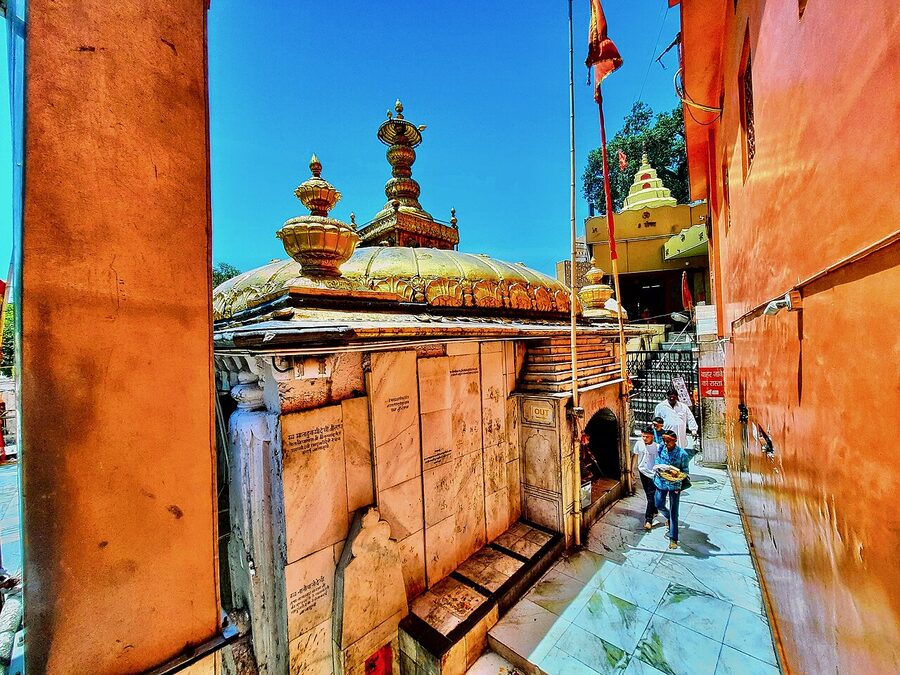
The structure is straightforward and the science is not. Inside the inner sanctum, set into a small square pit lined with copper, there is a fissure in the bedrock. From this fissure escapes a gas that is naturally combustible. The fissure is not a single opening but a small cluster of vents, and from each vent a flame rises. There are seven, eight, or nine of them depending on which source you read and which day you visit. The flames are blue at the base and yellow at the tip. They hiss faintly. They have been burning, the temple’s tradition says, since before the Mahabharata, in which the site is mentioned as a place of pilgrimage. They are not lit by the priests in the morning and snuffed at night. They burn through monsoon, snow, and the worst storms the Dhauladhar throws at the valley.
For a long time the flames were assumed to be a vent of natural gas seeping from a hydrocarbon reservoir below. This is the explanation Abul Fazl gave in the 16th century, he wrote of “mountain lights resembling lamps” and called them the natural effect of a sulfur mine. It is the explanation most modern visitors are content with. The complication is that government surveys, including drilling work in recent decades, have not been able to identify the source of the gas. The geology of this part of the lower Himalaya is not what you’d expect to host a producing hydrocarbon vent at over 600 metres above sea level. The flames are still there. Something is still feeding them. Whatever it is has not given up its location easily.
The temple’s position on this is sensible. The priests do not claim the gas isn’t real and they do not pretend the science isn’t unsettled. They will tell you, if you ask, that the goddess feeds the flame. They will also tell you, if you ask differently, that the goddess and the gas are the same thing and that pretending the two are in opposition is a misunderstanding the priests inherited from European visitors. You can take this however you want. The flames will be there either way.
The Shakti Peetha Story: How Sati’s Tongue Came to Rest Here
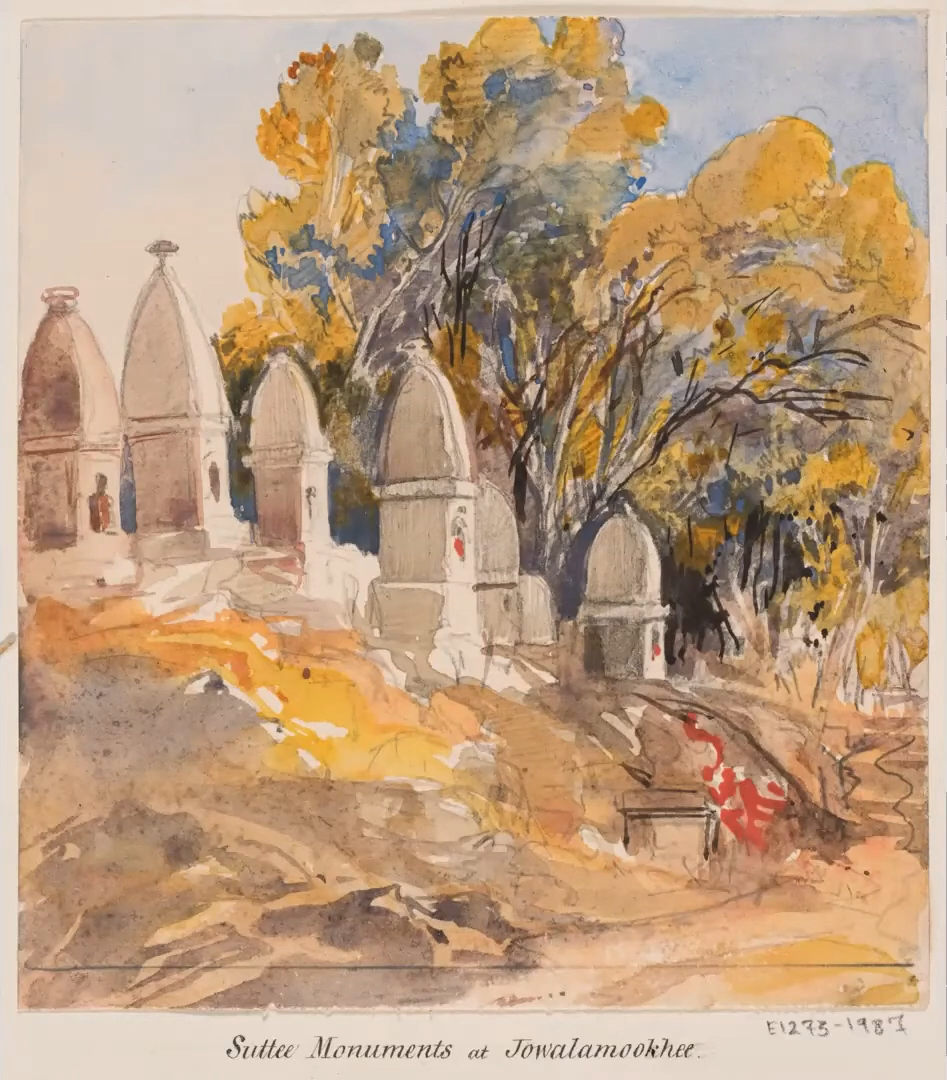
The Shakti Peetha tradition is one of the older organising principles in Hindu pilgrimage, and it pulls hundreds of disparate temples across the subcontinent into a single circuit. The story behind it is the death of Sati and the grief of Shiva.
Sati, in the version local sources tell at Jwalamukhi, was the daughter of Daksha Prajapati, raised in his household and married to Shiva against her father’s wishes. When Daksha later organised a great yajna and pointedly refused to invite Shiva, Sati went anyway. She was insulted. She immolated herself in the sacrificial fire rather than accept the slight to her husband. Shiva, when he heard, took her body in his arms and began to wander the three worlds in grief.
The wandering disturbed cosmic order. The other gods appealed to Vishnu for help. Vishnu released his Sudarshana Chakra, which struck Sati’s body and broke it into 51 pieces. Where each piece fell, a Shakti Peetha came into being, a place where the goddess could thereafter be worshipped in her dispersed and scattered form. Different lists count different sites; the most widely cited figure is 51, of which four are usually called the Adi Shakti Peethas and 18 the Maha Shakti Peethas.
At Jwalamukhi, what fell was Sati’s tongue. The tongue is fire. The tongue is the part of the body that speaks the goddess’s word. The flame in the rock is the tongue continuing to speak. This is not a metaphor the temple deals in lightly, it is the structural reason why there is no idol. An image would represent the goddess. The flame is the goddess. Putting an idol in the inner sanctum would replace her with a statue of herself.
The wider story matters because it places Jwalamukhi inside a network. The Vajreshwari temple at Kangra, twenty-odd kilometres away, holds Sati’s right breast. The Naina Devi temple in neighbouring Bilaspur district holds her eyes. Chamunda Devi at Palampur is associated with her feet in some local accounts and with the Mahishasura Mardini form of Durga in others. Chintpurni in Una district sits within the same circuit. Pilgrims who come to Jwalamukhi typically travel a longer Devi-darshan loop that takes in three or four of these sites in a single trip. We’ll come back to the circuit later in the piece.
The Cowherd, the King, and the Building of the Temple
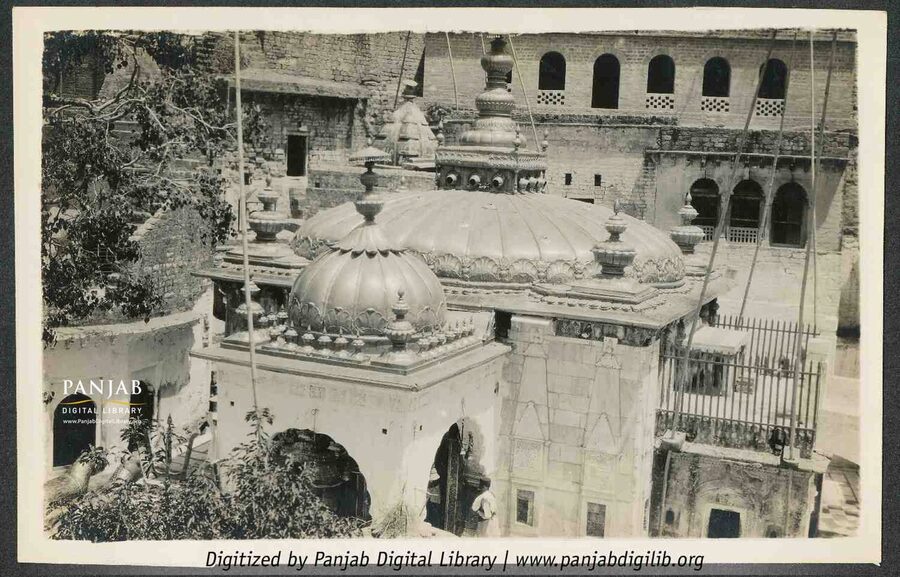
The tongue fell. For a long time, by the local legend, no one knew exactly where. The location was lost to memory.
The discovery story, which is the founding myth of the temple as a built structure, runs like this: a cowherd in the Kangra hills noticed that one of his cows refused to give milk in the evenings, no matter how full the udder appeared. He followed the cow into the forest one day to see what was happening. The cow walked deep into the wooded slope, stopped, and stood quietly. A small girl appeared from nowhere, drank the cow’s milk, and disappeared in a flash of light. The cowherd ran to his king with the story.
The king at the time was Raja Bhumi Chand Katoch of the Katoch dynasty, the ancient Rajput line that ruled the Kangra hill state. Bhumi Chand was a devotee of Durga. He knew the local legend that Sati’s tongue had fallen somewhere in his territory. He sent men to find the spot the cow had led the cowherd to. They could not. Years passed. The cowherd came back to the king with a second sighting, he had seen, on the same wooded slope, a flame burning out of the rock with no fuel. Bhumi Chand went himself this time, found the spot, had a darshan of the flame, and ordered a temple built there.
The Katoch dynasty’s involvement is part of why the temple is so deeply embedded in the local devotional ecology. The Katochs are still the recognised custodial family of several Kangra temples, and the local pandas (the priestly families who maintain the genealogical registers that pilgrims consult to trace their ancestry) have served at Jwalamukhi for generations. If you visit and someone offers to look up your family’s bahi at the temple, this is a real, centuries-old service. The bahis are still kept.
The earliest extant historical text to mention the temple by name is the Tarikh-i-Firuz-Shahi, written in the 14th century by Shams-i Siraj Afif. It records that Firuz Shah Tughlaq, the Delhi Sultan, visited Jwalamukhi during a campaign against Kangra. Tughlaq was not a devotee. The visit, by his court historian’s account, was curiosity. But the visit had a consequence that matters for Indian intellectual history: Tughlaq found a library of more than 1,300 Sanskrit volumes at the Nagarkot temple complex, and he ordered a substantial number of them translated into Persian. This is one of the earliest documented translation programmes between Sanskrit and Persian, and it is what tells us, indirectly, that Jwalamukhi was already a major learned centre by the 1350s.
A Chinese envoy is reported to have described “a place where hot and cold water came out of calcareous rocks” around 650 CE; Alexander Cunningham, the founder of the Archaeological Survey of India, identified this place as Jwalamukhi. Whether Cunningham’s identification is correct is debated by modern historians. What is not debated is that there was something on this site long before the present temple structure went up.
Akbar and the Flame That Wouldn’t Go Out
The most repeated story at Jwalamukhi is the Akbar story, and it is worth telling in two versions because the versions disagree.
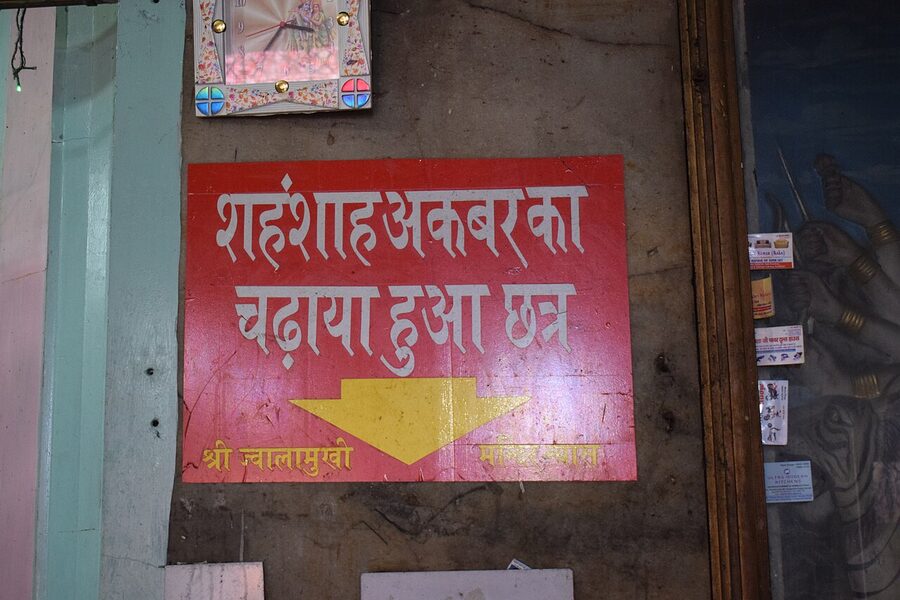
The popular version: Akbar, having heard about the eternal flames, came north to test them. He was sceptical of the goddess’s power and thought the flames must have a mundane source. He tried to extinguish them with an iron disk over the fissure. The flames came up around the disk. He had a stream of water diverted to the pit. The water boiled off and the flames kept burning. Defeated, Akbar acknowledged the goddess and presented her with a chhatri, a parasol of beaten gold. As he was leaving the temple, the chhatri turned to a base metal (copper, in some versions; an unidentified metal in others) because the goddess was not interested in his offering on his terms. The transformed parasol, or a parasol presented as such, is on display at Jwalamukhi today and is one of the most-photographed objects in the temple precincts.
The historical version, which is what you find in academic temple-history sources rather than devotional pamphlets, is more sceptical of Akbar’s interest. The Tirtha Yatra account (which is itself a devotional source, but a more careful one) holds that Akbar was not a devotee at all. He came to suppress the temple, not to worship there. He attempted to extinguish the flames specifically because he wanted to discredit the goddess. The chhatri offering, in this reading, was not penitence but a calculated political gesture, and the metal-transformation story is later embellishment.
What is left after you set both versions side by side is this: the temple has a long-standing story of a Mughal emperor who tried to put the flame out and failed. The story is part of what makes the place feel inviolable to its pilgrims. Which version you choose to believe says more about your reading of Mughal religious policy than it does about the temple, and the temple itself is comfortable letting both stories stand.
The Nine Flames and What Each Goddess Stands For
The flames have names. The traditional count, repeated in the temple’s own materials and in most editorial sources, is nine, though older travellers’ accounts speak of seven, and the count varies because the smaller vents flicker on and off. The nine are each named after a form of the goddess.
The central and largest flame is Mahakali. Around her, in clockwise order as you stand at the pit, are Annapurna (the goddess of food and nourishment, whose shrine at Kashi is the most famous), Chandi (the warrior form who slew Mahishasura), Hinglaj (a Shakti Peetha goddess from what is now Balochistan in Pakistan, whose flame burning here ties Jwalamukhi into a circuit that crosses an international border), Vidhya Vasini (also called Vindhyavasini, the goddess of the Vindhya range), Mahalakshmi (the goddess of prosperity), Saraswati (the goddess of learning), Ambika (a maternal Devi form), and Anji Devi. Some accounts add Bhasni (also written Basni) as a tenth, which is why the count slips between nine and ten depending on who is doing the counting.
This naming is not arbitrary decoration. Each named flame links Jwalamukhi to a specific other temple or pilgrimage tradition somewhere else in the subcontinent. The Hinglaj flame links to Hinglaj Mata in Balochistan, a Shakti Peetha that pilgrims used to walk to until the 1947 Partition closed the route. The Vindhyavasini flame links to the Vindhyachal temple in Mirzapur. The Annapurna flame links to Kashi. By naming the flames after the other Devi traditions, the temple at Jwalamukhi positions itself as a kind of unified seat where all the major forms of the goddess can be worshipped at one fissure. You don’t have to walk the whole subcontinent. You can stand at one pit and address them all.
In practice, devotees offer milk and water at the pit, and oblations of ghee, sugar candy (mishri), and seasonal fruit. The most distinctive offering is rabri (thickened sweetened milk) which is the goddess’s bhog and is one of the temple’s specific food traditions. Local sweet shops along the lane up to the temple sell rabri in small terracotta pots for offering, and the prasad you receive after the bhog aarti will frequently include it.
Inside the Mandir: What You’ll Actually See
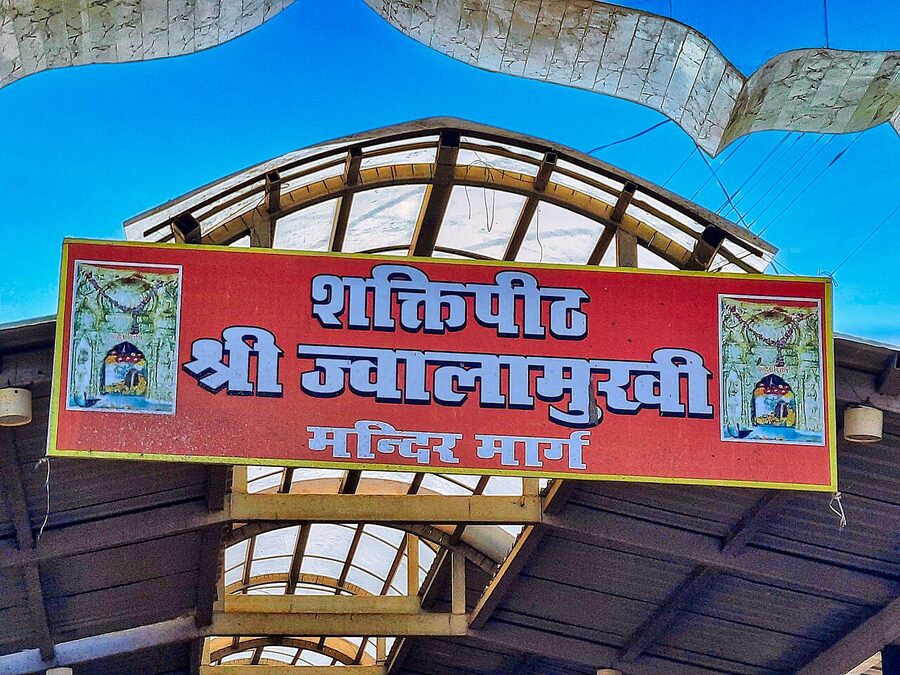
The current structure is what you get after centuries of renovation. The base of the temple is older (local sources credit the original construction to the Pandavas during their period of exile, which is the standard “ancient” attribution Hindu temples get when no firm date is available) but every visible surface above ground level has been rebuilt or re-clad multiple times.
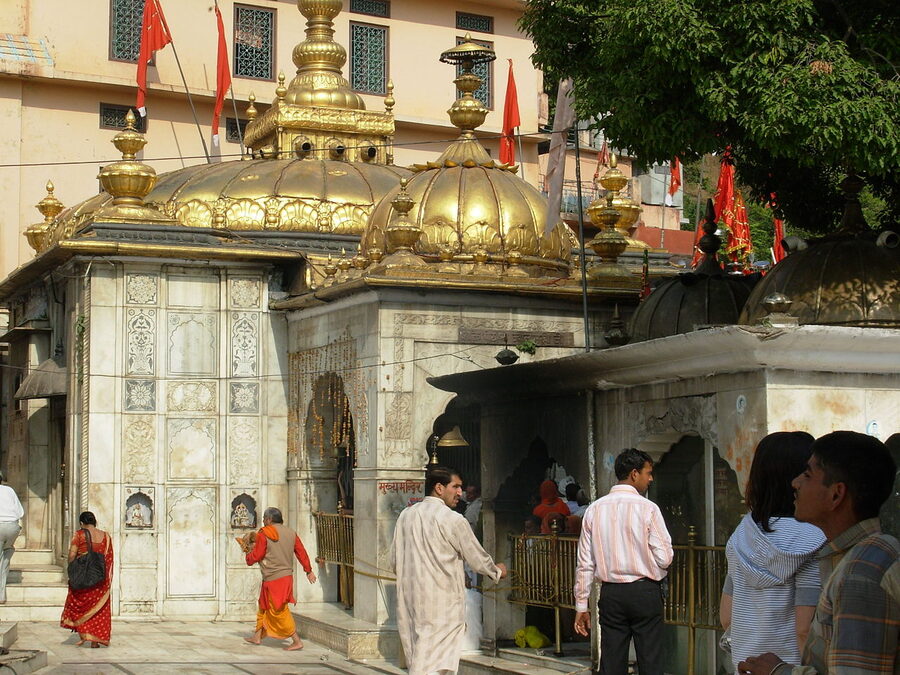
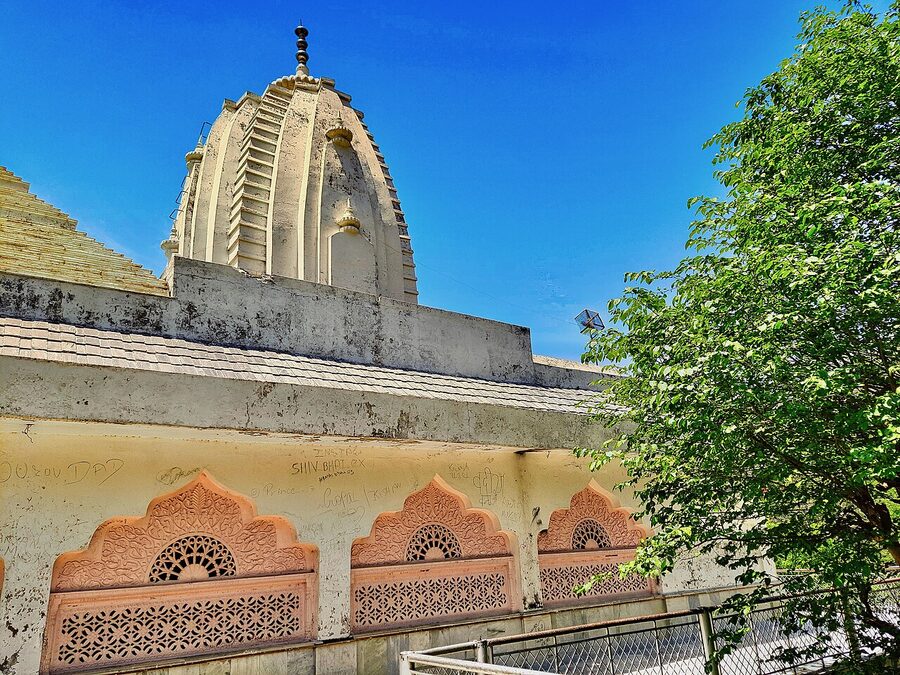
The dome is gilt. Maharaja Ranjit Singh’s son Kharak Singh donated the gold plating in the early 19th century, which is also when the silver-plated folding doors at the front of the sanctum were installed. The donation is recorded in temple inscriptions. Above the inner sanctum, the dome rises in a stepped form with three kalashas of decreasing size stacked on top of one another and a chhatra (a small canopy) on the topmost.
At the entrance, two stone lions stand guard, their stylisation more Pahari than the standard Nagara temple-lion form. Inside, immediately past the doors, is the mandap (the pillared hall) which contains a large brass bell donated by the King of Nepal in the late 19th century. Devotees ring the bell on the way in and on the way out. The bell is loud enough that you can hear it from the lane below the temple, and on a busy darshan day it never stops.
The inner sanctum is small. It would not seat thirty people. The pit is in the centre, surrounded by a low railing. There is a paved walkway around the pit so that you can do parikrama, the clockwise circumambulation that is part of every Devi darshan. Above the pit, on a small platform, the priests perform the various aartis. To the side of the main pit is a smaller pit where the bhog offerings (the milk, the rabri, the fruit) are made. The smoke from the flames has darkened the dome’s interior over the centuries; the gold plating inside the roof, donated alongside Kharak Singh’s outer gilding, is mostly obscured by soot now and would need a major restoration to be visible again.
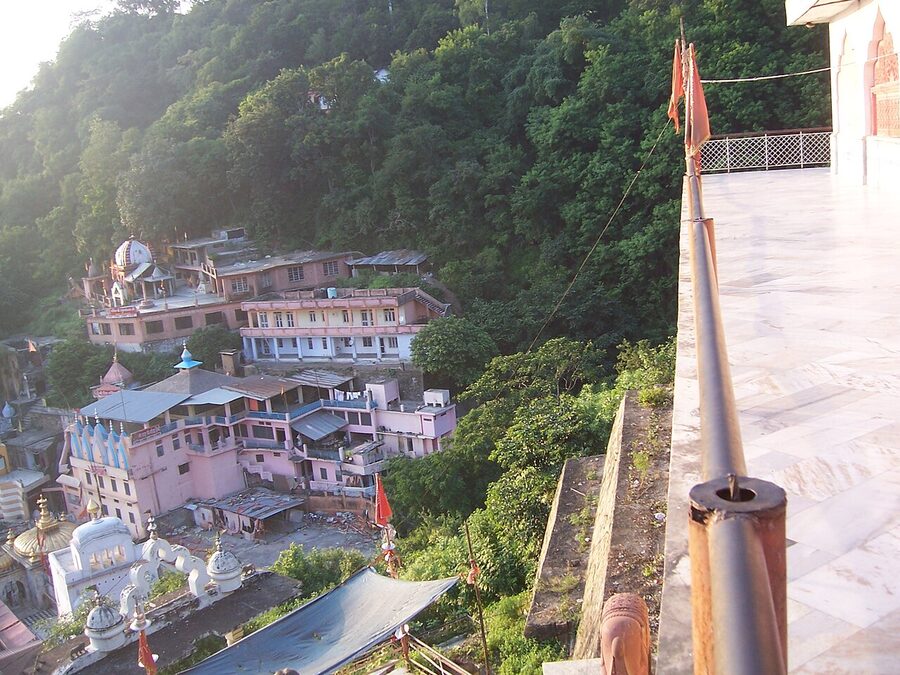
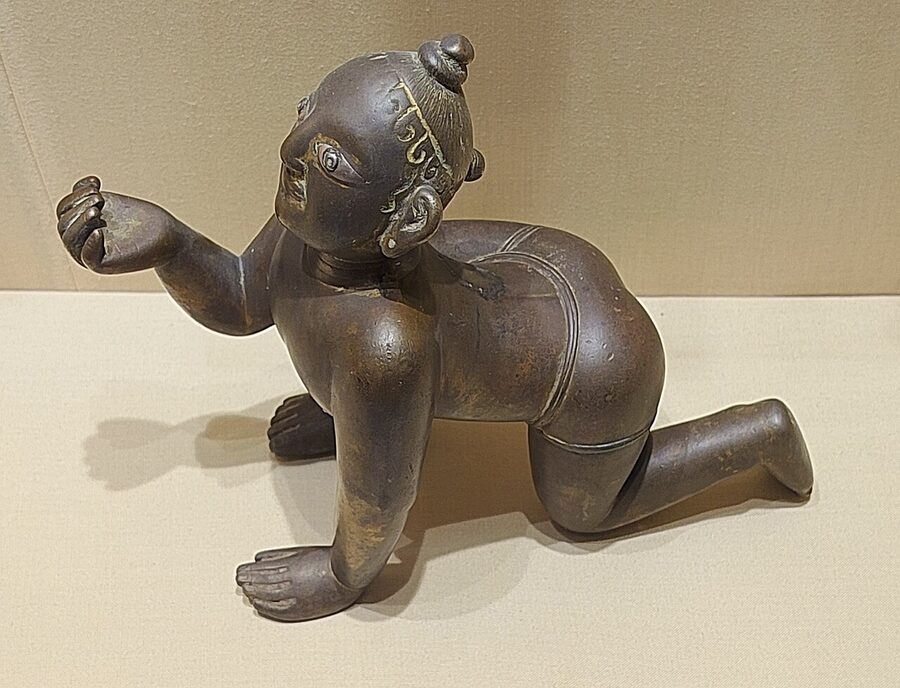
Outside the main sanctum, within the broader temple complex, are smaller shrines to other deities, a Bhairava shrine (Shiva in his fierce form, present at every Shakti Peetha), a Hanuman shrine, an idol of Bal Gopal, and a couple of subsidiary devi shrines added at various points over the centuries. The standard darshan route takes you past these on the way out.
The Daily Aartis: Five Times, Day and Night
The Jwalamukhi aarti schedule is the spine of the day. Five aartis are performed, each with its own name and character, and the priests chant Vedic Sanskrit hymns at each. Havan (the daily fire offering) is performed in the morning, with portions of the Durga Saptashati read aloud.
The first aarti is Mangal Aarti, performed early morning around 5 a.m. as the temple gates open. This is the awakening aarti, the goddess being roused from sleep. Crowds are thinnest at this hour, and if you can be standing at the silver doors when they open, you’ll get the closest darshan of the day. Through the winter, the gates open closer to 7 a.m. and the Mangal aarti shifts accordingly. Verify the time on the Kangra Temples portal before you set your alarm.
The second aarti, the Panchopachara Pujan, takes place at sunrise. This is the formal worship with the five offerings, flower, incense, lamp, food, water. It is short, around twenty minutes, and immediately follows the Mangal aarti. Many morning pilgrims attend both back-to-back.
The mid-morning Bhog ki Aarti happens between 11 a.m. and noon. The goddess is offered the day’s bhog (rabri, mishri, seasonal fruit, and milk) and the offering is then distributed as prasad. This is the busiest of the five aartis on most days; the temple is fullest, the queue is longest, and the prasad distribution after lasts well into the afternoon.
The fourth aarti is performed in the early evening, around 7 p.m., with no special name in most schedules. It marks the transition between day and night worship and is generally well-attended.
The last aarti is Shayan Aarti, also called Saiyan Aarti. It happens at 9 p.m. or 10 p.m. depending on the season. This is the goddess being put to bed. The bed of Devi (a small ceremonial bed in a side room called the sejabhavan) is decorated with fresh flowers, ornaments, and silk dresses. The aarti is performed in two phases: first inside the main temple at the pit, then inside the sejabhavan. During the second phase, the priest reads from the Soundarya Lahari, the great hymn to the goddess composed by Adi Shankaracharya. Of all five aartis, the Shayan is the one most often described by visitors as the most affecting. The temple has gone quiet, the day’s crowds have left, and the small ritual of putting the goddess to sleep happens in lamp-light against the constant blue glow of the flames.
If you can only attend one aarti, attend Mangal at opening or Shayan at closing. The middle three are crowded and the goddess feels like a logistics problem. The bookend aartis are when the temple is herself.
Navratri and the Two Big Fairs
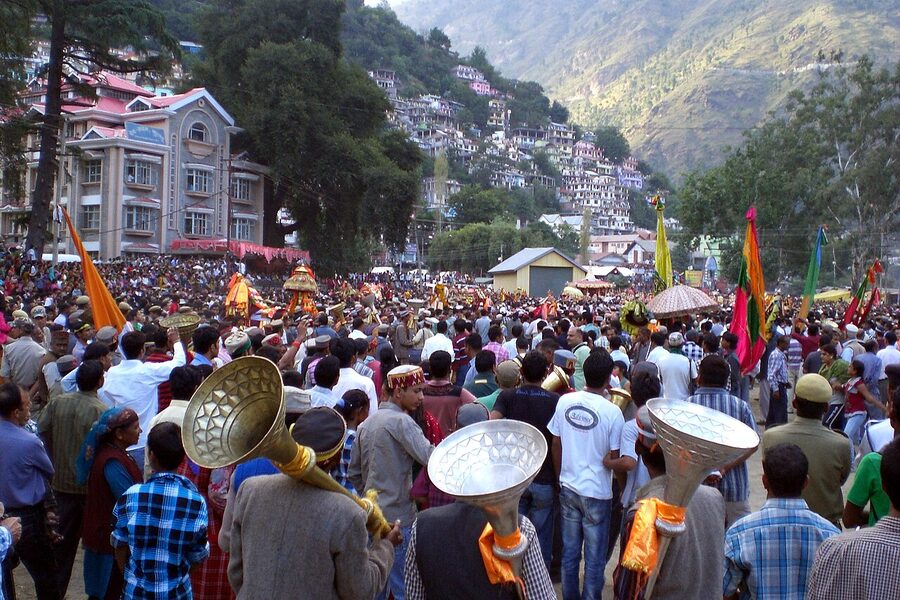
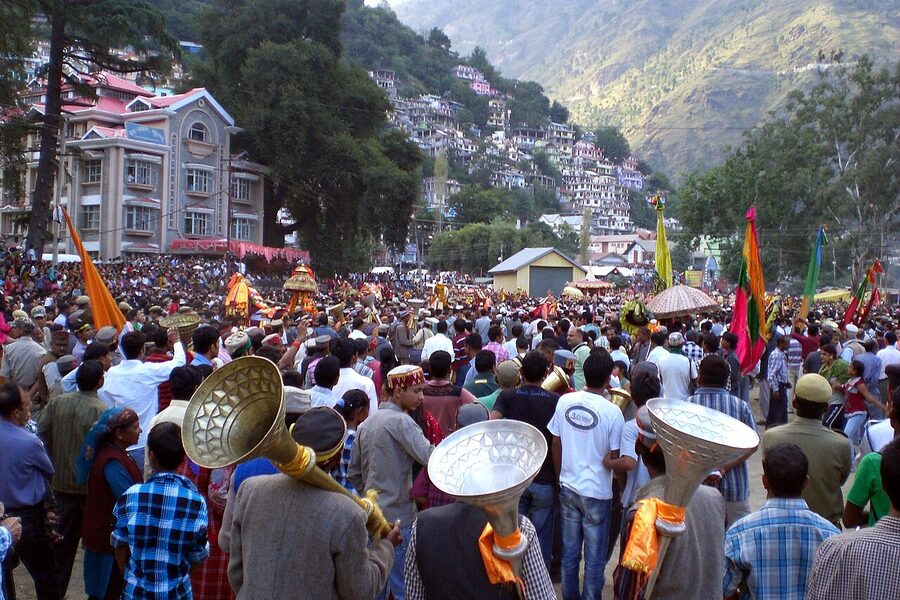
The temple has two annual fairs, both tied to Navratri. The spring fair, in the lunar month of Chaitra, falls in late March or early April. The autumn fair, in Ashvin, falls in late September or early October. Each fair runs for the nine days of Navratri and the temple sees crowds of tens of thousands per day, with the population of Jwalamukhi town doubling for the duration.
Pilgrims arrive carrying red silk flags called dhwaja or jhanda. The flag is offered to the goddess and tied at the temple, where it joins thousands of others. The perimeter walls and railings disappear under layers of red cloth. Some flags are huge, carried in procession from villages a day’s walk away. Some are small, bought at the lane shops below the temple by visitors who have come without one. The dominant visual of Navratri at Jwalamukhi is red: red flags, red threads tied at shrines, red bridal sarees worn by women coming to seek the goddess’s blessing on a marriage.
The fair itself is a working mela. Stalls sell prasad ingredients, shawls, brass puja items, framed prints of the goddess, sweets including the rabri the goddess prefers, and the small terracotta lamps used in evening worship. Folk performances run on a stage near the maidan: Pahari folk songs, plays drawn from the Devi Mahatmya, and wrestling matches that are a Kangra tradition during temple fairs. A separate cluster of stalls handles the bhog distribution, which during the fair runs throughout the day rather than just after the bhog aarti.
If you can choose, the autumn (Ashvin) Navratri is the more atmospheric of the two. The weather is cool, the post-monsoon air is clear, and the late-September light on the gilt dome is the picture every photographer in Kangra is trying to take. The spring (Chaitra) Navratri runs into hotter weather and the lane up to the temple is more uncomfortable in the afternoons. Either way, book your accommodation at least four to six weeks in advance, the small handful of hotels in Jwalamukhi town fills up quickly during the fairs, and the closest substantial overflow capacity is in Kangra town or Dharamshala.
Shivaratri is also marked at the temple, though on a much smaller scale. As a Shakti Peetha, Jwalamukhi maintains a Bhairava shrine, and Shiva is worshipped here in his Bhairava form on Shivaratri night with a separate jagran (all-night vigil). The crowds are a fraction of Navratri size and the experience is correspondingly more intimate. Coverage of Shivaratri at Jwalamukhi is thin in most travel writing, which is part of the case for going.
Getting to Jwalamukhi
The town sits roughly halfway between Kangra and Hamirpur, on the SH22 alignment that links the two. Distances and travel options:
By air: The nearest airport is Gaggal, also known as Kangra Airport or Dharamshala Airport, about 46 kilometres north. Gaggal handles flights from Delhi and Chandigarh; the Delhi connection is the most reliable. From Gaggal, a pre-paid taxi to Jwalamukhi costs roughly 1,500 to 2,000 rupees and takes around 90 minutes depending on traffic through Kangra town. There is no direct airport bus.
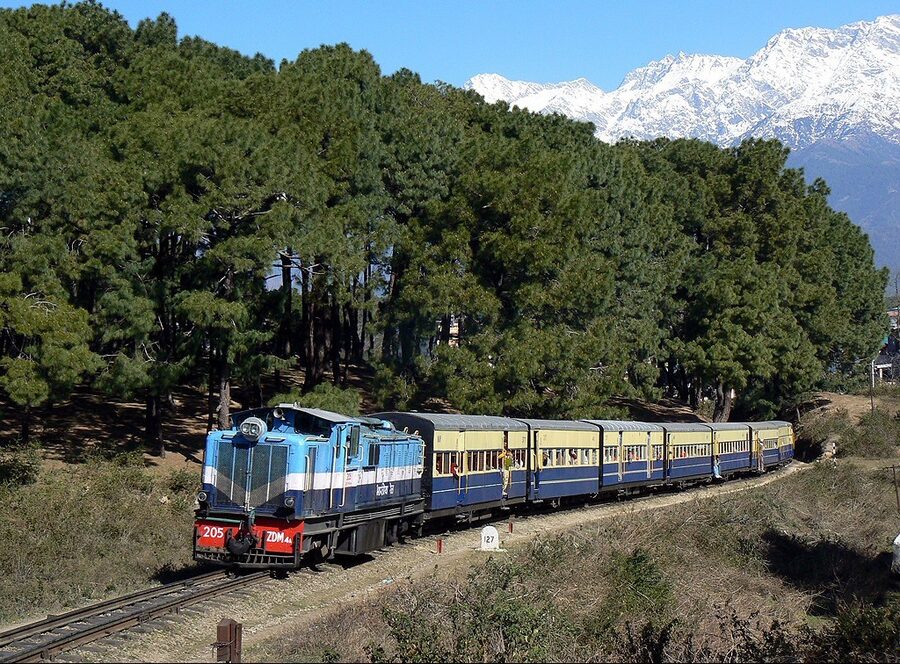
By train: Two railway options. The narrow-gauge Kangra Valley Railway has a station at Kangra Mandir, about 30 kilometres from Jwalamukhi, a slow, scenic ride from Pathankot but not the choice if you’re trying to get there quickly. The broad-gauge railhead is at Pathankot, 123 kilometres away, with regular trains from Delhi (overnight Jammu Mail and others) and connections from across north India. From Pathankot, a taxi to Jwalamukhi takes about three hours; bus services are frequent and cheap but slower.
By road from Delhi: The most direct route is the 460-kilometre drive via NH44 to Ambala, then NH54 and NH503 through Una to Hoshiarpur, then NH3 and SH22 through Mubarakpur and Chintpurni to reach Jwalamukhi. The drive is long (plan on ten to twelve hours including stops) and most pilgrims break the journey at Chintpurni, doing a darshan there in the morning before continuing to Jwalamukhi for the afternoon aarti. Direct overnight Volvo buses from Delhi ISBT Kashmiri Gate are operated by HRTC (Himachal Road Transport Corporation) and several private operators; the Delhi-Kangra Volvo will stop at Jwalamukhi if you ask.
By road from Chandigarh: Around 230 kilometres via Una and Hoshiarpur, six hours by car. Buses run every 30 to 60 minutes from Chandigarh’s ISBT-43 terminal.
By road within Himachal: From Dharamshala, 56 kilometres south through Kangra town, around two hours by taxi. From Hamirpur, 40 kilometres east, ninety minutes. From Manali, around 240 kilometres via Mandi and Bilaspur, a long day’s drive that most people break at Palampur or Kangra. From Shimla, 250 kilometres via Bilaspur and Una, also a long day.
HRTC runs frequent buses on the Kangra-Hamirpur axis through Jwalamukhi. The bus stand is at the foot of the temple ridge, a five-minute walk from the steps up to the entrance.
Where to Stay in Jwalamukhi Town
Jwalamukhi is a pilgrimage town, not a hill station, and the accommodation reflects that. Most options are basic hotels and dharamshalas (pilgrim guesthouses) clustered along the lane that leads up to the temple and on the approach road from Kangra. Standards range from spartan to modestly comfortable; nothing in town is what you’d call a destination property.
For the lowest budget, the temple committee operates a yatri niwas with very basic rooms at fair prices, intended for pilgrims rather than tourists. Booking is on-the-day at the office near the bus stand. Rooms have a bed, a fan, an attached bathroom with a bucket. You won’t get hot water in winter without asking.
Mid-range options include several family-run hotels with names you’ll recognise from any small north-Indian pilgrimage town, Hotel Jwalaji, Hotel Jwala Residency, and a handful of similarly named places along the approach. Rooms run roughly 1,500 to 3,500 rupees a night depending on season and amenities. Air-conditioning is standard in summer-season pricing. None of these properties is on Booking.com or the major OTAs in any reliable way; the safest approach is to call ahead, and during Navratri to book directly four to six weeks in advance.
If you want a substantially better property and don’t mind a 30-kilometre drive each morning, base yourself in Kangra town or in one of the established Himachal hill stations within reach. Dharamshala has the widest selection of hotels in the region, see our Himachal hotels overview for a wider survey of options. Several heritage and boutique properties around Palampur (45 kilometres east) make Jwalamukhi a half-day excursion rather than the centre of the trip, which suits travellers who want the temple but also want comfortable evenings.
For honeymooners or travellers combining Jwalamukhi with a wider hill itinerary, our Himachal honeymoon guide sketches longer routes that include the Kangra valley alongside Manali and the Kullu side.
What to Eat and Where
You will eat well at Jwalamukhi if you eat simply. The town is small and the food is the food of the temple lane, vegetarian, north Indian, with a strong Punjabi-Pahari accent. The dhabas opposite the bus stand and along the approach road serve thalis at 120 to 200 rupees with three subzis, dal, roti, rice, and a small katori of curd. They are good. They are not memorable. They will fill you for a darshan day with no surprises.
The temple’s bhog itself is the most distinctive thing you’ll eat in town. Rabri (the thickened sweetened milk offered to the goddess) is sold by a row of sweet shops along the lane up to the temple, and the lane is worth walking slowly even if you have no intention of buying anything. Each shop will press a small cup on you for tasting. The rabri at Jwalamukhi is denser and less sweet than the Mathura or Vrindavan version most readers will be familiar with, with a slightly smoky undertone the local sellers will tell you comes from the slow simmer over wood fires. It does come from that. Buy a small terracotta pot to offer at the temple, and a second one to eat afterwards.
Mishri (rock sugar candy), batashe (small puffed sugar discs), kheer (rice pudding, the Himachali version made with cardamom and almond), and small packets of dried fruit prasad fill out the standard offering set. You can buy a complete bhog tray from any of the lane shops for 100 to 250 rupees depending on what’s on it.
For Pahari cooking proper (Sidu, Madra, Babru, Chha Gosht, the dishes we cover in the Himachal festivals food section) Jwalamukhi is not the destination. You’ll find better and more committed Pahari cooking in Kangra town, in Palampur, and across the Dhauladhar at McLeod Ganj. Make a day-trip lunch out of one of those if Pahari food is what you came for; Jwalamukhi itself does the Punjabi-Pahari fusion of a temple-town lane and does it competently.
Langar (community meals) is served at several points around the temple complex during the Navratri fairs. The largest langar runs near the main entrance and is open to anyone, free, sit-down on the floor. The food is simple (dal, rice, roti, one subzi, kheer for dessert) and the experience of eating with a thousand strangers in a single hall is one of the things Navratri at Jwalamukhi does best.
The Other Temples Around Jwalamukhi
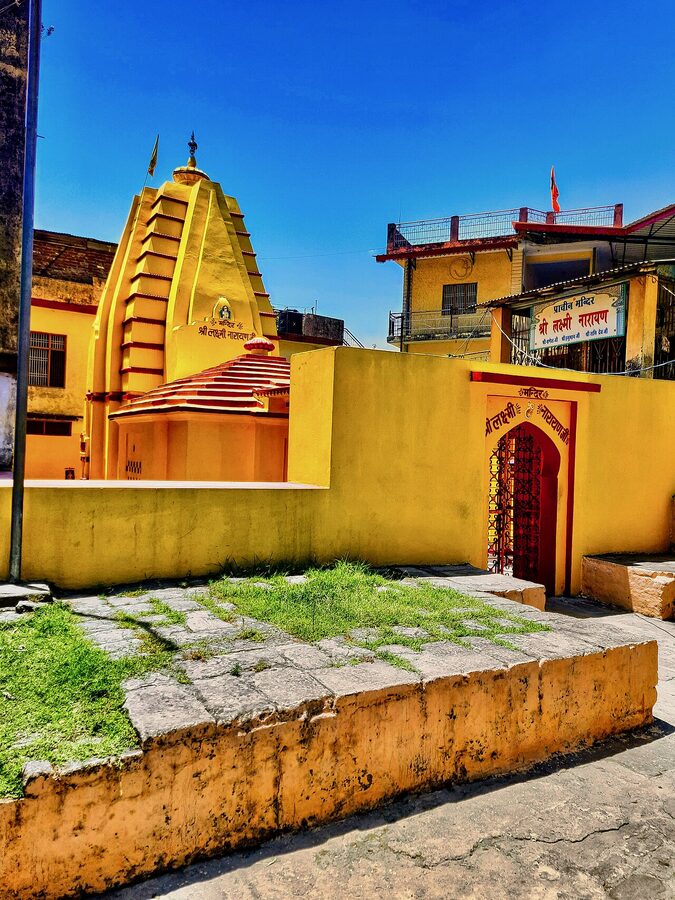
Jwalamukhi sits inside a dense cluster of smaller temples, several of them within walking distance of the main shrine. Most pilgrims do at least three of these as part of a single visit, and the temple staff at Jwalamukhi can point you up the right paths.
Tara Devi Temple is the most-visited of the immediate cluster. The temple is on the ridge directly above Jwalamukhi, accessed by a flight of around a hundred steps up the back of the main temple. Tara Devi is one of the Mahavidya forms of the goddess (she is associated with knowledge and protection) and the climb up to her shrine is the standard “second darshan” of a Jwalamukhi visit. The view from the top, back down across the temple’s gilt dome and out across the Beas valley, is the photograph most visitors take home.
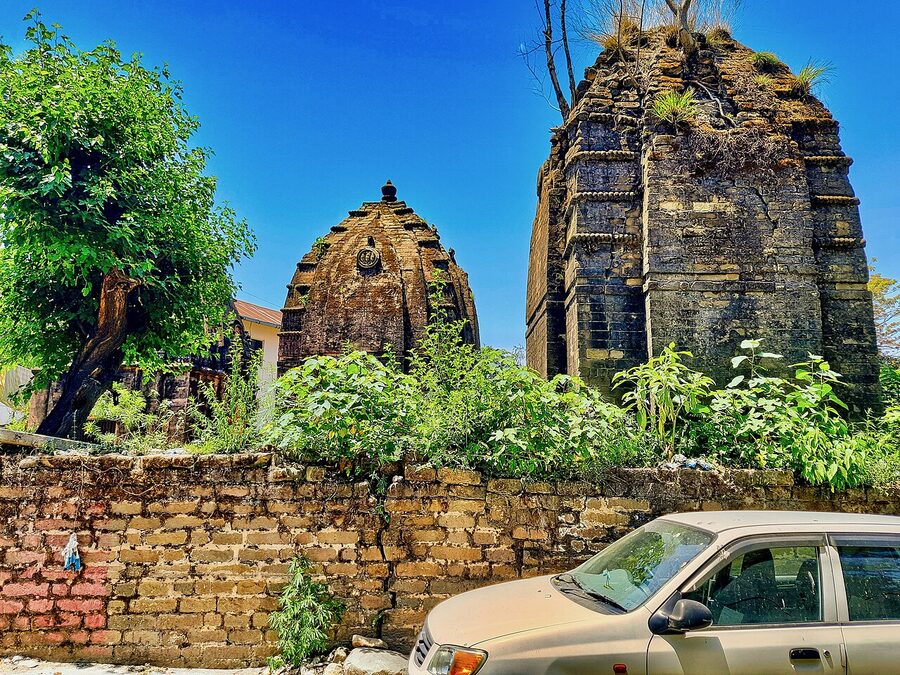
Ashtabhuja Mata Temple sits about a kilometre from the main temple on the same ridge. Ashtabhuja means “eight-armed”, and the goddess here is worshipped in the eight-armed form of Durga. The temple is small, ancient, and rarely crowded, a counterpoint to the noise and crowding at Jwalamukhi proper.
Sri Raghunath Ji Temple, also called Teda Mandir, is about five kilometres from Jwalamukhi on the Kangra road. The dedication is to Lord Rama, with Sita and Lakshman, and local tradition holds that the trio stayed at this site during the fourteen-year exile. The connection to Lord Raghunath also makes this a useful stop for visitors who have read our piece on Kullu Dussehra, which centres on the same deity in his Kullu form.
Nagini Mata Temple sits about four kilometres from Jwalamukhi on the same approach road as Raghunath Ji. The goddess here is associated with the Naga (serpent) tradition and an annual fair is held in July or August.
Arjun Naga Temple is the closest of the cluster, directly to the right of Jwalamukhi’s main entrance, accessed by climbing 200 stairs from the front gate. The deity is, again, a Naga form, with Arjuna of the Mahabharata associated with the foundation. The climb is steep; the temple at the top is small.
Bagulamukhi Temple at Bankhandi is 36 kilometres from Jwalamukhi and falls outside walking range. Bagulamukhi (also spelled Baglamukhi) is one of the ten Mahavidyas and is associated with victory over enemies, devotees come specifically to seek the goddess’s intervention in legal disputes, business rivalries, and family conflicts. It is a destination in its own right and a worthwhile half-day side trip if you have a vehicle.
The Wider Shakti Peetha Circuit in Kangra
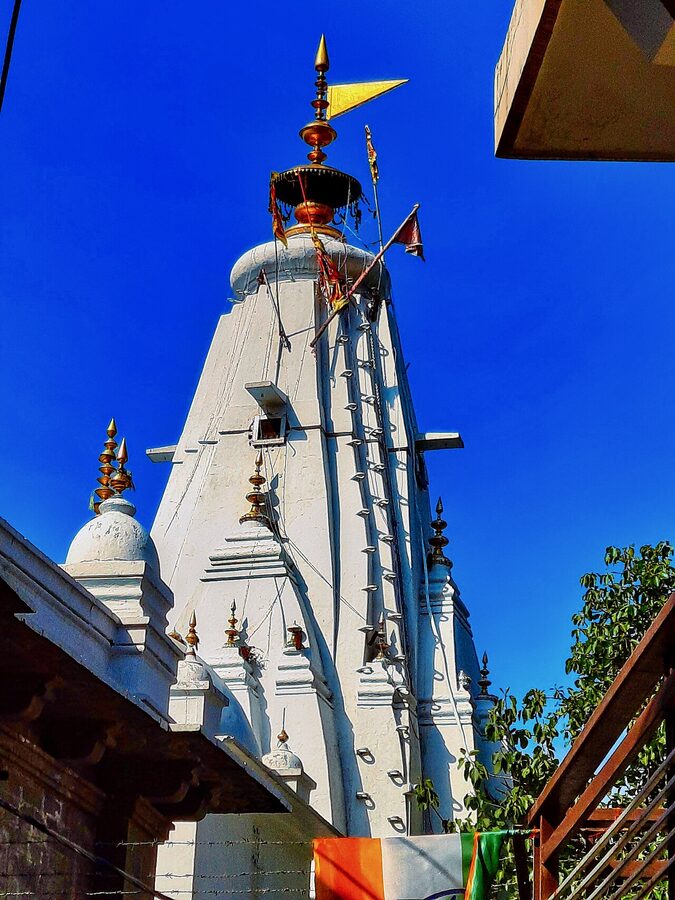
If you’ve come this far for a Shakti Peetha and you have two or three days, do not stop at one. The four major Devi shrines of Kangra district are typically done as a single circuit, and the order most pilgrims follow places Jwalamukhi second of four.
The standard sequence: Chintpurni first (in Una district, 65 kilometres south of Jwalamukhi). The goddess at Chintpurni is Chinnamastika (the headless form) and the shrine is one of the most-visited Devi temples in north India after Vaishno Devi. The temple sits on a small hilltop reached by a kilometre-long lane of shops; queues are long; the darshan is fast.
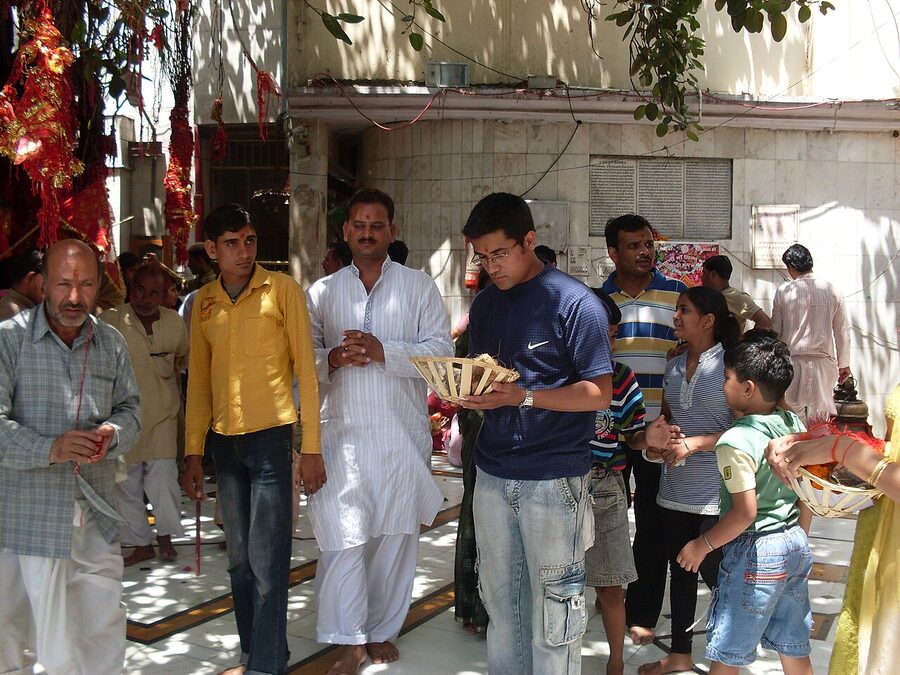
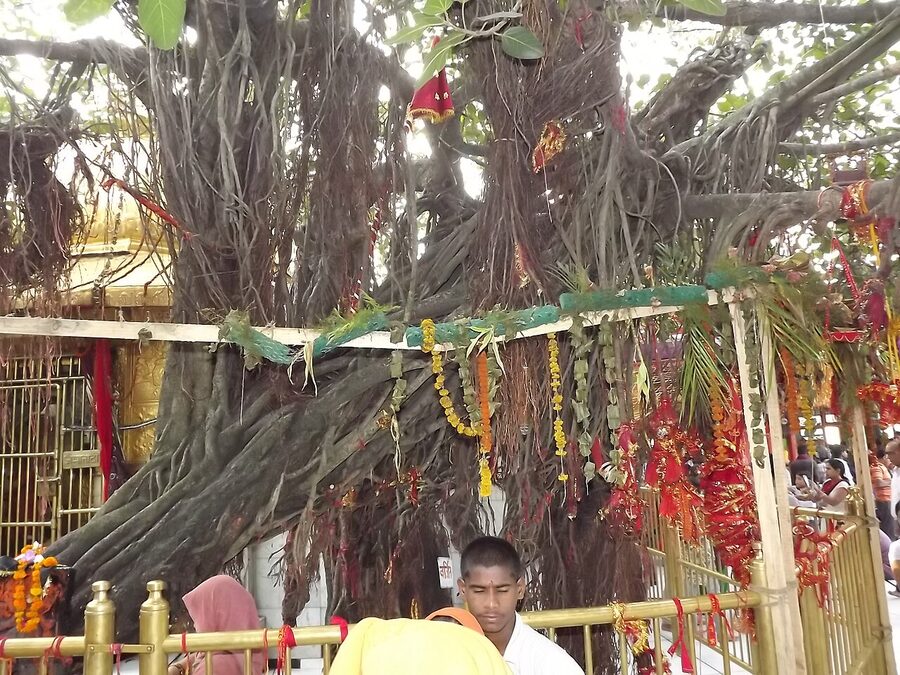
From Chintpurni, drive north to Jwalamukhi (this guide). Then continue north 25 kilometres to Vajreshwari Devi Temple at Kangra town, where Sati’s right breast is held. The temple was substantially destroyed during Mahmud of Ghazni’s raid in 1009 CE (Mahmud made off with a famous treasury of gold and jewels that had been accumulating at the temple for centuries) and the present structure is a 19th-century reconstruction after the 1905 Kangra earthquake levelled the previous building. The temple sits in central Kangra town and is part of any tour of the wider Kangra Fort area.
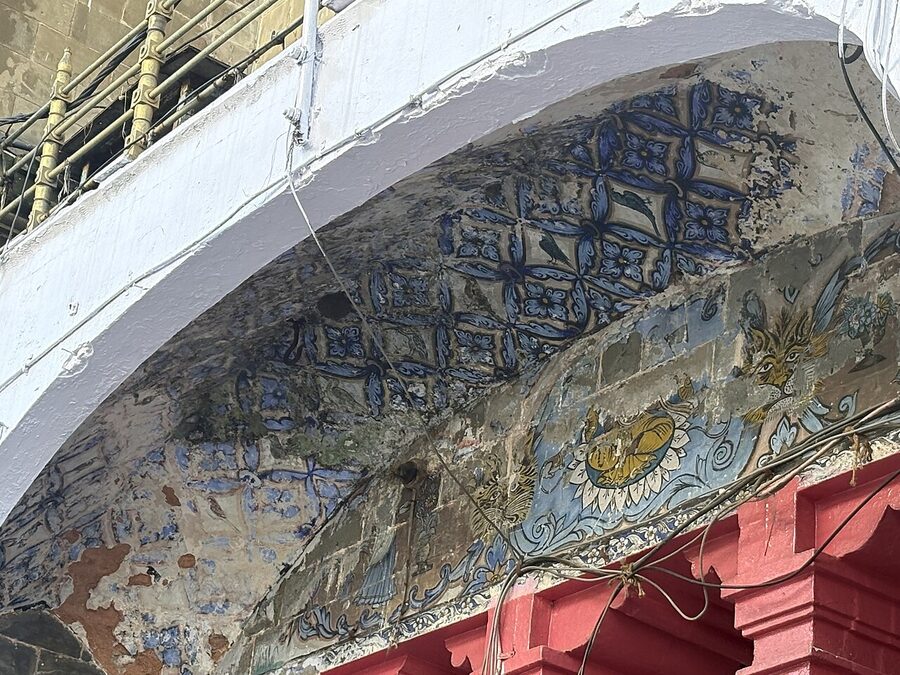
Finish at Chamunda Devi, 25 kilometres east of Kangra at Palampur. Chamunda is the fierce form of Durga who slew the demons Chanda and Munda. The temple sits on the bank of the Baner river, overlooking the Dhauladhar range. This is the most scenically located of the four Kangra Shakti Peethas and the one travellers tend to remember most clearly. Palampur itself is a tea-garden town and a comfortable place to stay, with several heritage hotels in old colonial bungalows.
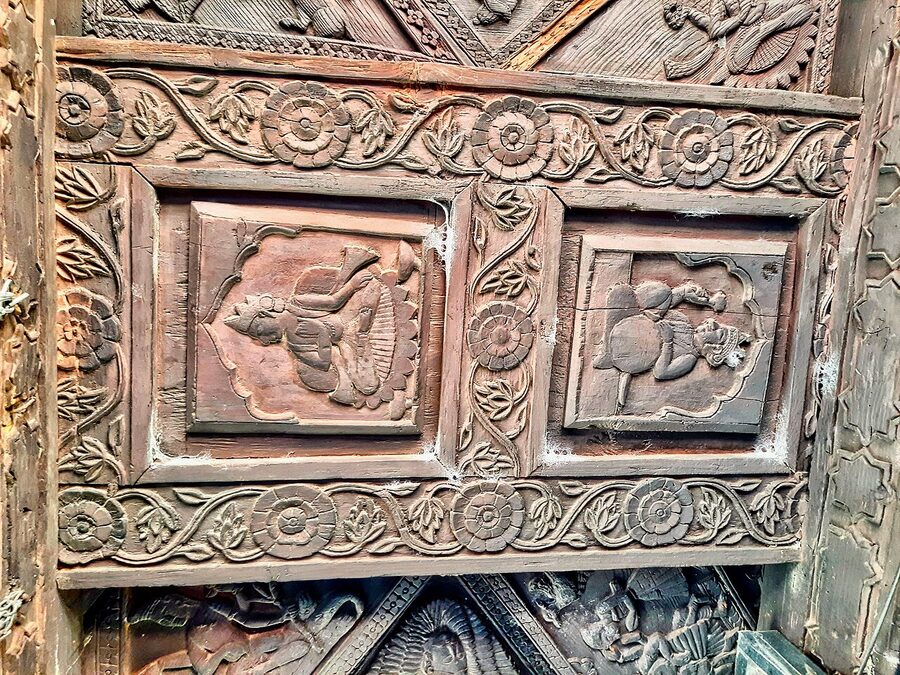
Add Naina Devi in neighbouring Bilaspur district if you have a fifth day; she holds Sati’s eyes and the temple is on a hilltop above the Govind Sagar reservoir, a long but spectacular drive south. Many pilgrims combine Naina Devi with Chintpurni at the start of the circuit rather than at the end.
For a fuller picture of the regional context, including festivals at each temple, see the calendar of fairs and festivals across Himachal. The site’s overview of Himachal tourist attractions places the Kangra circuit within the wider state, and the Lahaul and Spiti guide covers the Buddhist temple traditions on the high side of the range.
Practical Notes for Your Darshan
A short list of things that are not obvious until you’re standing at the temple gate.
Shoes off at the entrance. There is a free shoe deposit on either side of the main steps, collect a token, leave your shoes, pick them up on the way out. Do not leave valuables in your shoes. Socks are fine but bare feet are traditional and the floor is cool, not painful.
No dress code as such, but cover your shoulders and legs. Western women in shorts or sleeveless tops will not be turned away but will draw stares; a long kurta and loose trousers, or a salwar suit, is the simplest solution. Indian male visitors arrive in everything from formal kurta-pyjama to jeans and t-shirt; the temple does not particularly care.
Photography is not allowed inside the inner sanctum. You can photograph the exterior, the dome, the lions at the gate, and the lane up to the temple. Inside, where the flames burn, phones go away. There are guards. They will say something. Don’t argue.
Carry your offerings in a basket sold at the lane shops. The standard puja thali at Jwalamukhi includes a small earthen pot of rabri, mishri, batashe, a coconut, a red chunni for offering, incense, and a packet of dhoop. The complete tray is 150 to 250 rupees depending on what’s in it. You can buy individual items separately if you want to be selective.
Queues are managed by metal railings inside the temple complex. On normal days you’ll move through the darshan in 30 to 45 minutes. On Tuesdays, Saturdays, and Sundays (the busiest weekdays) expect 60 to 90 minutes. During Navratri, expect three to four hours. The aarti times are when queues compress; if you’re queue-averse, target the gap between aartis (mid-morning before bhog, or mid-afternoon).
VIP darshan tickets exist but are inconsistent. The temple committee has, at various points, sold a paid fast-track ticket; at other points the system has been suspended. Ask at the office near the bus stand on the day. Cost when available has been around 300 to 500 rupees per head.
Mobile signal is patchy. Jio and Airtel work most of the time; BSNL is the most reliable for older Indian SIMs. Do not count on data inside the inner complex, the sanctum is at the bottom of a concrete pit beneath the dome, and signal there is essentially zero.
Cash for offerings, UPI for shopping. Most lane shops now take UPI. The temple’s hundi (donation box) takes only cash, bring small denominations.
Time for the visit. A single darshan with one aarti takes two hours. A complete visit including the surrounding shrines (Tara Devi, Ashtabhuja, the lane walk) takes a half-day. Plan a full day if you want both Mangal and the bhog aarti, or Mangal and a side trip to Bagulamukhi.
When to Go (and When to Avoid)
Kangra district has a four-season climate. Each season changes what a Jwalamukhi visit feels like.
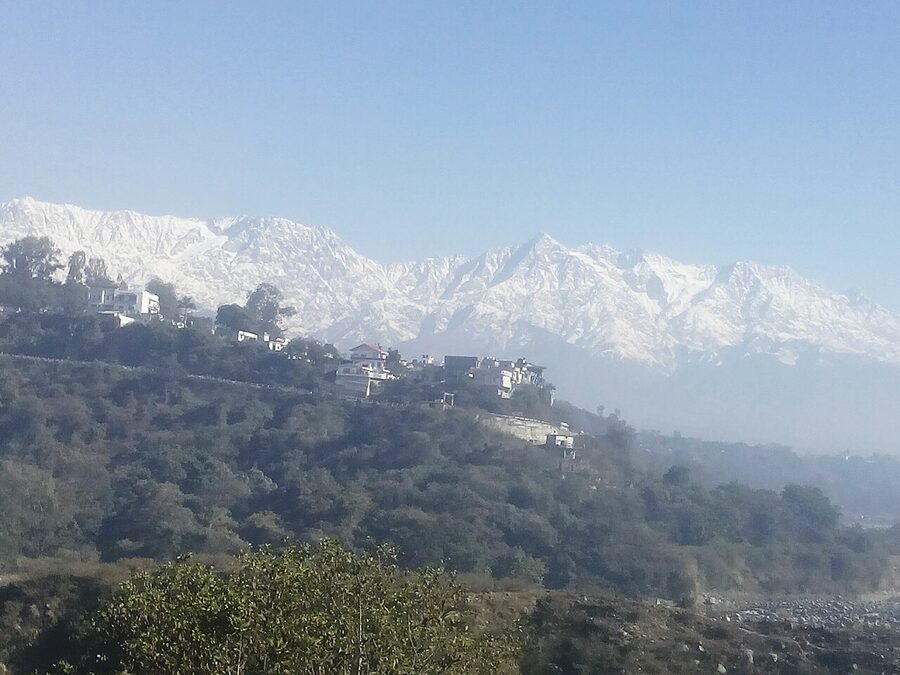
October to February is the best window. The post-monsoon air is clear, mornings are crisp, and the Dhauladhar range to the north is visible in the distance from the temple’s higher viewpoints. Ashvin Navratri (late September to early October) falls right at the start of this window and is the single best time to visit if you can handle crowds, the temple is at its most atmospheric and the weather is comfortable. Daytime temperatures through November and December run around 18 to 22 degrees, dropping to 4 to 8 at night. Light woollens are enough; you don’t need serious winter gear.
March to mid-April is the second window. Chaitra Navratri falls in this period and the temple is busy. Daytime temperatures climb to 25 to 30 degrees by April, which is when the lane up to the temple gets uncomfortable in the afternoon sun. Mornings are still pleasant.
Late April to June is the hot pre-monsoon period. Daytime highs reach 35 to 40 degrees in May and the lane is a hard climb in the heat. The temple itself stays cool (the inner sanctum is below ground level and the flames keep the air warm but circulating), but the approach is uncomfortable. Crowds are at their lowest in this window, which is the case for going if you want a quiet darshan and don’t mind the heat.
July to September is the monsoon. The Kangra hills get heavy rainfall and the temple lane can be slippery. The dhwaja flags hang heavy and water-darkened. The flames burn the same as ever, they are inside the rock and the rain doesn’t reach them, but moving around the town is harder. Roads to the smaller surrounding temples (Tara Devi, Arjun Naga) close intermittently due to landslips. The Nagini Mata fair in July or August is the only major event during the monsoon period.
Avoid weekends if you can. Weekday darshans, especially Wednesday through Friday, are far less crowded than the Tuesday-Saturday-Sunday rush.
The flame doesn’t care which day you come. It’s been burning longer than the calendar has existed, and it’ll be burning when you leave.
Pick the season that suits the rest of your trip and go.
For more on Kangra and the wider hill-station network across the state, the Himachal attractions overview sets out the connections, and our tour package guide covers operator-led options for visitors who’d rather not self-drive the long Delhi-Kangra approach.
External authorities and further reading: The official Kangra Temples portal maintained by the Himachal Pradesh government carries the verified aarti timings and festival dates. The Kangra district administration publishes pilgrimage and festival advisories. Incredible India has Jwalamukhi listed in its Shakti Peetha section, and the Wikipedia entry, sourced primarily from Shanti Lal Nagar’s The Temples of Himachal Pradesh, is the most-cited summary of the historical record.